

Table of Contents
- Key Takeaways
- Introduction: Content Marketing
- Popular Content Marketing Tactics
- Content Marketing & The Marketing Funnel
- 7-Step Guide for Effective Content Marketing
- Conclusion
Key Takeaways
- Content marketing techniques you can deploy right away.
- How each stage of the marketing funnel is represented – with examples.
- How to drive prospects into loyal customers and fierce brand advocates.
- A complete guide to developing an effective content marketing campaign.
Introduction: Content Marketing
The term Content Marketing probably conjures up various marketing concepts in people’s minds – especially if you have not been directly involved in the industry.
According to the State of Content Marketing Global Report by Semrush (2023), 77% of the companies that enjoyed the most success from content creation are planning to increase their content marketing budgets.
Popular Content Marketing Tactics
Content Marketing is a critical aspect for any business wanting to compete for their fair share of today’s consumer marketplace.
It is typically comprised of the following types of Digital Marketing strategies/tactics:
- E-Books
- Podcasts
- Webinars
- Newsletters
- Case studies
- Blog articles
- White papers
- E-publications
- Landing pages
- Social media posts
- Video sharing sites
- Interactive content
- Downloadable tools
- Colorful Infographics
- Original data research
- Responsive website content
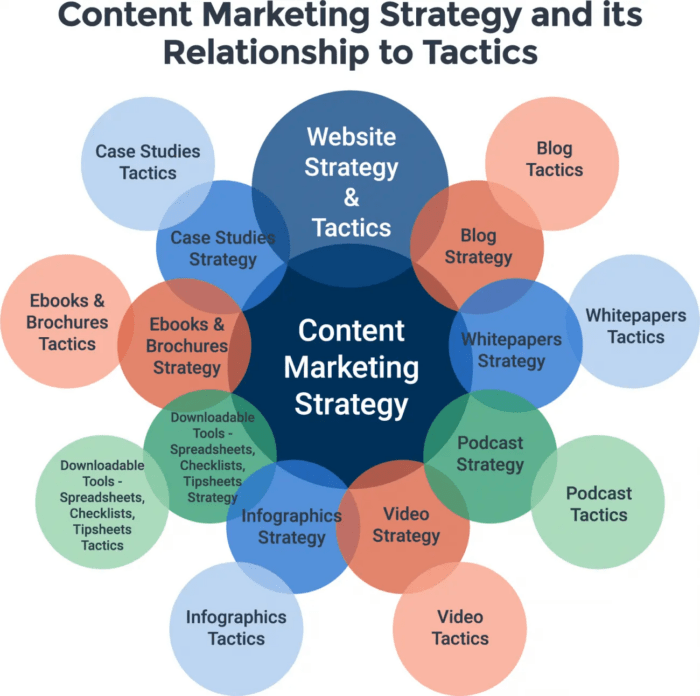
Source: Infographic courtesy of SmartSheet.
Content Marketing & The Marketing Funnel
The Digital Marketing Funnel (also referred to as the Digital Customer Lifecycle) consists of the following general stages: Awareness, Consideration, Retargeting, Conversion and Loyalty.
Since Content Marketing can be deployed at each and every layer or stage of the funnel, we will look at some examples and explanations of how it might be utilized…
The Awareness Stage (Top of Funnel Example)
- This is the phase where Content Marketing is probably the most effective – and the phase where people first get introduced to your company.
- A well written blog article or timely e-publication can go a long way towards explaining what types of products or services your brand offers the consumer, why the consumer needs your products or services, and what can your product or service provide to the consumer.
- For example, a CPA who recently opened his own private practice and specializes in preparing tax returns for small businesses and entrepreneurs, may post a blog article at the beginning of tax season on the website of the local chamber of commerce and his Google Business Profile, outlining “tax deductions which save small business owners thousands.”
- This can go a long way towards introducing your new office to local customers, and begin to establish you as an authoritative source on a particular topic.
The Consideration Stage (Top of Funnel Example)
- This is the phase where you would distinguish yourself from the competition, and increase consumer interaction with your brand.
- You likely already have the prospects e-mail address and maybe even their social media accounts.
- For example, you might engage in a campaign of sending periodic e-mails with various case studies attached.
- You would show how you successfully helped different clients, along with ratings and reviews you received from those clients.
The Retargeting Stage (Middle of Funnel Example)
- This is the phase when a customer has already visited your website or blog, but has not yet decided to make a purchase or engage your services.
- Retargeting ads (which work by installing “cookies” on a web browser) can be used to redirect a prospect back to a specific page (e.g., a landing page on your website).
- The landing page may include a colorful infographic.
- The infographic may show a comparison between your company’s prices and services, and its closest competitors.
The Conversion Stage (Bottom of Funnel Example)
- This is the stage where the prospect indicates they are ready to become a paying customer, and they actually go forward with their intentions.
- You may still need to nudge the prospect along with some timely communications and offers.
- For example, you might send the prospect an e-mail directing them back to your website content.
- They can use a temporary promo code sent with the e-mail to save 25%, if they agree to sign up or make a purchase within the next 24 hours!
The Loyalty Stage (Bottom of Funnel Example)
- Once this stage is reached, the customer is already committed.
- They may have even converted into an advocate for your brand.
- Content Marketing is still very much in play at this stage.
- For example, if you are a consumer products company, you might communicate additional product offerings to the customer, send thank you e-mails, or encourage membership in your loyalty program.
- Uploading YouTube videos or posting blog articles which provide guidance on setting up a product, overall maintenance, or tips on submitting a warranty claim, are good examples of content marketing uses at this stage of the funnel.

7-Step Guide for Effective Content Marketing
There are seven (7) logical steps you can follow in order to develop an effective Content Marketing campaign designed to create a loyal customer base.
They are as follows:
1- Set Your Goal
Are you trying to increase e-mail newsletter sign ups? Maybe you are seeking to improve your customer conversion rate from 3% to 4% (a 33% increase) over the next 18 months.
Do you need to raise awareness about a new product or service your company is getting ready to launch?
Whatever your goal, it should be defined in writing, specific enough to be measured by analytics and reasonable enough to be attainable.
An educational content provider may have the following goal: Increase YouTube channel subscribers and course sign-ups by 10% over the next 12 months.
To accomplish this, they may offer a free downloadable case study of current and former students from their website or YouTube channel, discussing the inherent convenience, affordability, and career-enhancing value of educational video sharing content.
2- Define Your Customer Persona(s)
This will help you to determine the specific target audience you are aiming to attract, what type of marketing message you wish to put forward, and what types of marketing materials may be the most effective at reaching your ideal customer.
See my blog article about creating customer personas, which provides an in-depth discussion on defining and developing customer personas and includes a Sample Template w/ Data for your digital marketing archives.
3- Audit Your Content
Good analytical software such as Google Analytics, or the analytical software bundled with a reputable Content Management System, will help you determine the following:
How many views are your content posts receiving? e.g., video uploaded onto YouTube.
How many times are people sharing your content posts? e.g., blog article on WordPress.
How many times has your content been downloaded? e.g., e-book publication sent via e-mail.
How many comments or likes have your posts received? e.g., Infographic posted on LinkedIn.
4- Choose a Content Management System
There are many good content management systems out there to choose from – I will list some of the more popular ones in Step 7 below.
Doing your own online research or asking other professionals for recommendations should also give you plenty of options.
A great example of a content management system is this WordPress platform I am using to write this blog post, and is considered one of the best on the market.
5- Engage in Brainstorming Sessions
Bounce new content ideas off other colleagues – if you have that opportunity – and see if you can come to some sort of consensus.
The marketing SaaS platform HubSpot recently identified fifteen (15) different activities in an article on brainstorming, that could be deployed individually or as a group.
6- Rely Upon a Content Calendar
These are specialized calendars that allow you to organize and schedule your content posting activities.
Think of a traditional calendar, a spreadsheet, a scheduling app, and a project management program all combined into one master platform.
7- Content Management Systems
In addition to WordPress, here are examples of four (4) more popular content management systems available on the market:
Buffer offers a social media toolkit for businesses
BuzzSumo is a “go-to” content marketing tool
HubSpot is an AI-powered customer platform
Hootsuite is an all-in-one social media management tool
Conclusion
How important is content marketing to your day to day business strategies?
What content marketing techniques have helped your company to grow the most?
Feel free to leave a comment below.
If you have not already done so, please don’t forget to Subscribe in order to receive periodic updates on valuable digital marketing strategies delivered right to your e-mail inbox!
See you in the next blog post…

 Insightful Digital Marketing