

Table of Contents
- Key Takeaways
- Introduction: E-mail Marketing
- E-Mail ROI Study by Industry
- Why Is E-Mail Marketing So Effective?
- Three Industry Grade Analyses Prior to Launch
- How to Create High ROI E-Mail Campaigns
- Quality or Quantity: Which Is Best?
- Segmenting Your Audience for Success
- Ethical Uses of Language in E-Mail Campaigns
- Five E-Mail Types to Help Reach Your Goals
- Persuade People to Open/Read Your Contents
- Common Mistakes E-Mail Marketers Make
- Conclusion
Key Takeaways
- What makes e-mail marketing so effective;
- How to apply professional analyses to your campaigns;
- How to produce e-mails that consistently create high ROI;
- How to start creating e-mails people will want to open and read;
- Avoid having your e-mails constantly marked as spam or unsubscribe;
- Ways to encourage people to click through to your promotional offers;
- What it takes to get recipients to share with their family, friends & colleagues;
Introduction: E-mail Marketing
As of 2020, according to a study by Litmus, e-mail marketing had an impressive average return on investment of $36 for every $1 spent. That would give you an average ROI of 36:1 or 3,600%!
Name an investment not considered a cryptocurrency asset that would return a greater ROI. Learn how you can leverage these stats and put together a profitable e-mail campaign.
Over 50 percent of the world’s population now uses e-mail – that’s more than 4 billion users! It is now estimated that over 300 billion e-mails are sent out every single day!
Regardless of what you may have heard, and despite the ever-increasing malware campaigns that exist, e-mail marketing remains one of the most effective methods of promoting a product or service.
E-Mail ROI Study by Industry
In a 2020 e-mail marketing study by Litmus, they further broke down the average ROI of e-mail marketing by the following industries:
- Media, sports, & entertainment: 32:1
- Software & technology industry: 36:1
- Marketing, PR, & advertising agency: 42:1
- Retail, eCommerce, & consumer goods: 45:1
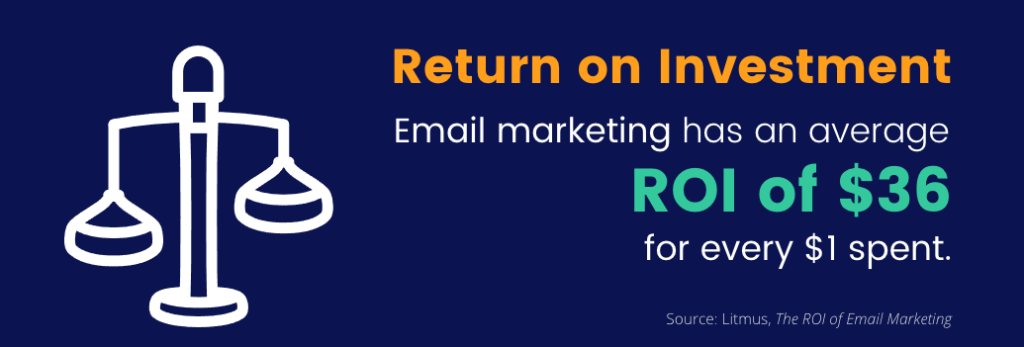
Source: Infographic courtesy of Litmus.
Why Is E-Mail Marketing So Effective?
Here is a breakdown listing the main reasons e-mail marketing is such an effective and profitable medium of marketing:
ROI – A whopping 3,600% average return on your investment or $36 for every $1 you spend on a branded e-mail campaign;
Lifespan – Over 50 percent of e-mail users keep the same active account for at least 10 years according to the Data and Marketing Association;
Analytics – Data can be collected and analyzed in real-time during an e-mail campaign (and immediately acted upon), as well as after the campaign itself has concluded; I’ll discuss later how an e-mail marketing automation platform like Mailchimp can provide valuable insights about your marketing efforts;
Subscription Length – People who subscribe to various e-mail lists tend to maintain that relationship for a very long time – I’ve been on my current financial institution’s list for 12 years, various social media lists for 15+ years, and an automobile club’s list for 18 years and counting;
Frequency and Consistency – Some e-mail communications are sent out daily, while others are sent out weekly or monthly. The frequency will of course depend on your product or service.
No matter how often e-mails are sent, one of the most important thing for a marketer to know is that their message is being communicated consistently, which means their products or services will remain top of mind with the consumer.
Reasons People Subscribe – What are the reasons you have chosen to subscribe to e-mail lists (I’m assuming you are on at least a handful of e-mail distribution lists)? There is a cross-section of reasons that people subscribe – here are a few of them:
- They enjoy learning about products and services that might enhance their life;
- The company sends out e-mails that are entertaining, informative, or both;
- The e-mails they receive are part of an ongoing story they have been following;
- They want to stay informed about breaking news, promotional announcements, law and regulation changes, product and service developments, etc.
- Receiving regular e-mails simply makes some people feel good and helps them to remain engaged on a day to day basis;
Three Industry Grade Analyses Prior to Launch
Similar to the way a company plans their product development, there are several preparatory things that should be done before launching a full scale e-mail campaign.
An auto manufacturer does not just take a bunch of random parts and throw them into an assembly line hoping everything will somehow fit together. Instead, the auto company plans each and every stage of the assembly line so that the finished product meets their design and engineering expectations.
Accordingly, a professional marketer does not just send out thousands of random e-mails to people hoping the results will somehow meet the goals of their key metrics.
Therefore, creating a successful e-mail campaign requires some meaningful analysis before you go all in.
Here are the three (3) key industry analyses to consider prior to building out your subscriber list and launching a campaign:
S.W.O.T. Analysis
- The first type of analysis goes by the acronym of S.W.O.T. and looks at internal factors facing a company. This can be further delineated as follows:
- S = Strengths
- What is unique about your company’s marketing resources?
- Does your marketing team bring certain strengths to the table?
- e.g., Design, copy writing, and idea innovation
- W = Weaknesses
- Are there any areas in which your marketing team can improve?
- Have certain aspects of your brand been neglected?
- Is there any additional training required to successfully run an e-mail marketing campaign?
- O = Opportunities
- What types of resources, events, or professional networking contacts would help your team create a more successful e-mail marketing campaign?
- T = Threats
- What types of campaigns are your competitors running?
- Are there any current events or situations that may be harmful to your brand?
- e.g., Negative publicity or pending lawsuits surrounding a product or service you offer
- S = Strengths
P.E.S.T.L.E. Analysis
- The second type of analysis goes by the acronym of P.E.S.T.L.E. and looks at external factors facing a company. This can be further delineated as follows:
- P = Political
- Have any new governing bodies taken office?
- Is there any geopolitical unrest affecting a country in which you are doing business?
- E = Economic
- What is the current state of the local and national economy?
- What things do your target audience consider important expenditures?
- S = Social
- What types of cultural events does your target audience follow?
- What is the general overall status of their education level?
- T = Technological
- How has the digital revolution changed the way people make purchasing decisions?
- What role is social media playing in people’s consumption habits?
- L = Legal
- What are the current regulations and laws on various e-mail functions? e.g., Junk (aka Spam), Unsubscribe, Opt-In, and Opt-Out
- Is there any pending legislation that might impact your upcoming e-mail campaign?
- E = Environmental
- What does sustainability mean to your potential e-mail recipients?
- Have there been any recent man-made or natural disasters affecting your target audience?
- P = Political
S.M.A.R.T. Analysis
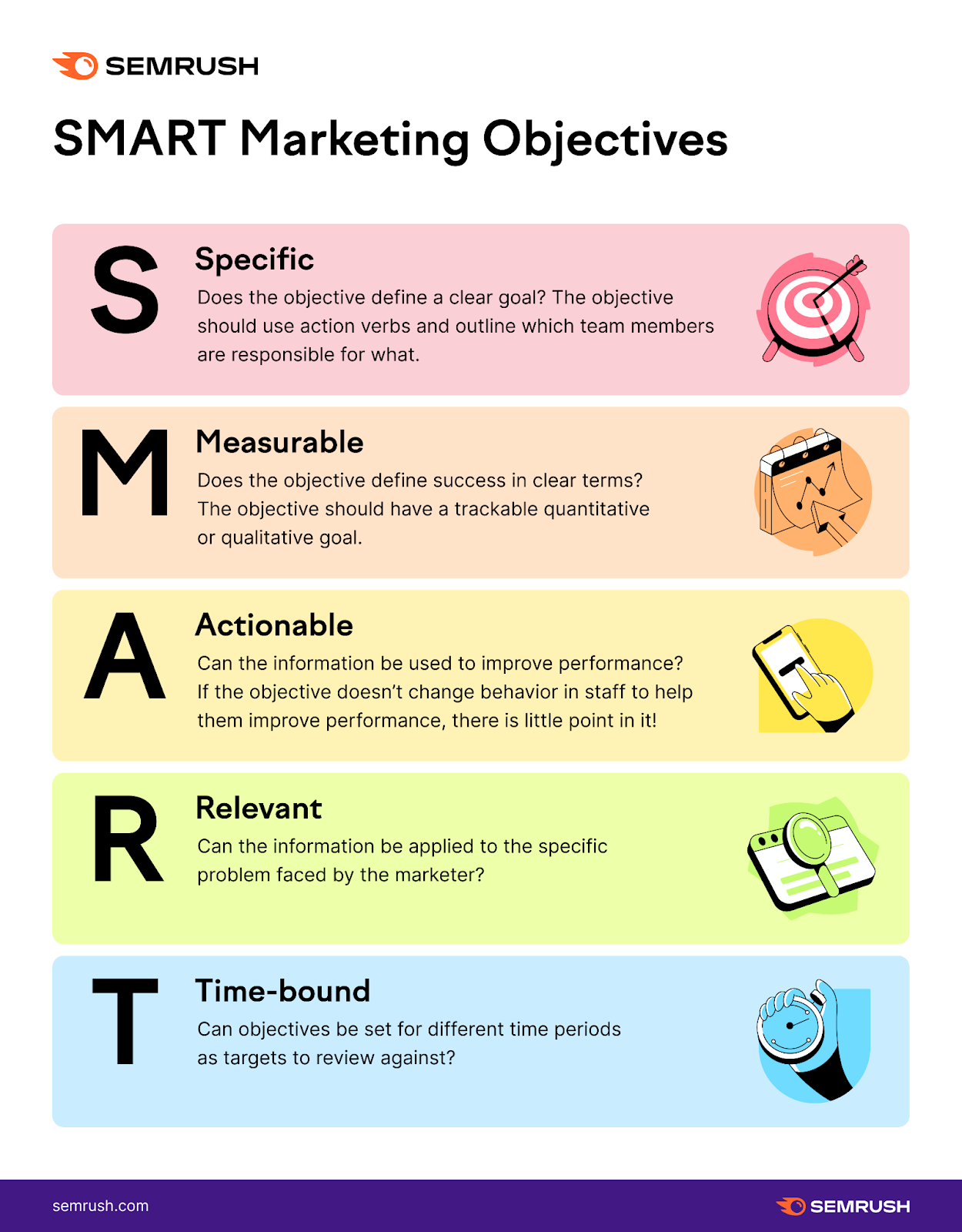
Source: Infographic courtesy of Semrush.
- The third type of analysis goes by the acronym of S.M.A.R.T. and looks at the actual goals of a company’s e-mail marketing campaign. The marketing SaaS platform Semrush posted the above SMART infographic in a recent blog article on content planning to better illustrate these marketing objectives.
- For example, if you are preparing an e-mail campaign for a new online health & fitness start-up company, they may have an overall business goal to increase their profits by 7% over the next 12-month period. In order to support that objective, you would create the following goals:
- S = Specific
- Send exclusive discount offers by e-mail to existing customers to increase repeat purchases
- M = Measurable
- Grow customer base by 500 users per quarter by improving SEO rankings
- A = Actionable or Attainable
- In support of a new fitness product launch, build the e-mail subscriber list by 10% over the next three months using targeted social media ads
- R = Relevant
- Create a referral program for existing customers in order to boost product sales
- T = Time-Bound
- Spend $2,500 on search engine ads over the next 90 days to raise overall brand awareness
- S = Specific
How to Create High ROI E-Mail Campaigns
Set Your Goals
These will normally align with your company’s overall business goals:
Brand awareness? You may be seeking to raise general awareness amongst consumers about your company brand. Perhaps you are wanting to introduce a new product or service into the marketplace.
Website traffic? Maybe your goal is to simply increase the total number of monthly website visitors – that alone can create a variety of positive effects.
New customer acquisition? Your company may be wanting to increase its customer base – e.g., achieve a 15% increase over the next 12 months via a generous referral program.
Brand loyalty? Your objective may be to generate additional repeat business and convert more customers into brand advocates for your products or services. This final layer or stage in the marketing funnel is the most important marketing objective a business can achieve!
Choose a Reputable Provider
There are several very good e-mail providers out there. It is important to screen the various providers to be certain you are utilizing the one that will give you the greatest chance of running a successful e-mail campaign. Here are some of the more popular services:
Mailchimp – an e-mail marketing automation platform;
HubSpot – an all-in-one CRM (customer relationship management) platform, that also offers e-mail marketing automation;
Constant Contact – an e-mail marketing automation platform;
Build Your Subscriber List
This should be an ongoing process and there are several ways in which this can be accomplished. The following are some viable approaches used by companies:
Offer an e-mail sign-up form or subscription page on your website or blog (like the e-mail subscription page I am offering on this website)
Post a sign-up form on your social media accounts
Offer something of value (a lead magnet) in exchange for an individual’s name and e-mail address – a free content marketing asset on your website or blog.
Examples include…
- A downloadable guide or study the consumer would find valuable;
- A software tool or calculator for a particular industry;
- A online webinar or conference event entry;
- A 1:1 consultation through Zoom;
- A newsletter on current trends;
Evaluate Brand Guidelines
Many companies have guidelines that need to be followed in order to establish and maintain their brand identity in the public’s eye. These can include items such as…
Logos
Jingles
Taglines
Illustrations
Color schemes
Font sizes and types
Determine Frequency
This is a very important consideration – should you be sending your e-mails out weekly, monthly, quarterly? How many times have you signed up for an e-mail communication, and found yourself being bombarded on an almost daily basis (sometimes multiple times per day) by various offers from the same company?
Measure Campaign Results
In order to measure the success (or lack thereof) of your e-mail campaign, you are going to need to track certain essential metrics. Here are some examples:
Bounce Rate
This measures the delivery rate. Did your e-mails actually arrive in the recipients’ in-box?
Note: To reduce the overall bounce rate of your email campaigns, include a notification at the bottom of your e-mails asking the recipient to add your e-mail address to their safe sender list.
Here is an example notification:
“Safelist us. In order to ensure delivery of e-mail communications to your inbox, please add us to your safe sender list or address book. Thank you.”
Open Rate
How many of the recipients bothered to even open your e-mail to read what you had to offer?
Click Through Rate or CTR
What percentage of people who opened your e-mail, continued to click through on a link you provided?
Conversion Rate
What percentage of people who opened your e-mail continued to click through on a link you provided and took some sort of conversion action?
In the real estate industry, for example, this may mean downloading a case study on the current state of the housing market or signing-up for a monthly e-mail newsletter for buyers and sellers in your regional area
E-mail Sharing or Forwarding Rate
What percentage of people clicked on a social media sharing button or a “forward to friend” button?
Unsubscribe Rate
A fairly self explanatory metric, but you will still want to know the percentages. Too high an unsubscribe rate may indicate you have chosen to send the right message, but to the wrong segment of e-mail recipients
Overall ROI
The overall return on investment for your e-mail marketing campaign
Calculation: Amount of Revenue from Campaign – Amount Invested in Campaign / Amount Invested in Campaign x 100 = Overall ROI
Example: $24,000 in Revenue – $1,000 Investment / $1,000 Investment x 100 = an Overall ROI of 2,300%

Quality or Quantity: Which Is Best?
If you want to set your brand up for long term success, then focusing on quality e-mail content (vs. sheer volume) will help you achieve that goal. You do not have to send out daily, or even weekly e-mails for your campaign to be effective.
If you are focused on producing quality content, your audience will look forward to receiving your communications – even if they are no more frequent than bi-weekly or monthly.
- For example, if you offer travel and leisure services, you may send your customers a monthly e-mail which highlights popular national park locations throughout the United States, or you may run a bi-weekly campaign which features different iconic cultural destinations from around the world.
Segmenting Your Audience for Success
You should be absolutely certain that the right message is being delivered to the in-boxes of the right audience. Segmentation involves dividing your customers into smaller, more manageable groups.
This division is usually based upon criteria such as demographics, lifestyles and interests, geographic location, purchase history, and time zone – just to name a few.
- For example, if you had an office supply business, then you would want to separate out your lower-volume individual consumer accounts from your larger-volume business accounts, and tailor separate e-mail messages and offers to each of those segments.
Ethical Uses of Language in E-Mail Campaigns
In order to achieve your goal of running a successful e-mail campaign, you should be following ethical and moral principles. The language you use in your e-mail communications plays a big part in helping you achieve that goal.
The wrong type of language can put your brand’s integrity at risk and flag the e-mails in your campaign as “junk.”
If the tone of your e-mails affects people as being manipulative, exaggerated, desperate or in any other way offensive, then your company’s reputation will suffer in the eyes of the consumer, and even longtime, loyal customers, may decide to jump ship.
For example, using language in an e-mail subject line such as “Urgent” or “Won’t Last” or “Act Now” or “Best Offer Ever” will come across as manipulative, and not genuine or trustworthy.
Replacing that language with a simple “20% Off + Free Shipping” or “Check Out New Eco-Friendly Styles” will do a lot more to attract business that any type of hyperbolic language.
Another bonus: your e-mails will be far less likely to be flagged as spam or junk!
Five E-Mail Types to Help Reach Your Goals
There are a variety of e-mail types that can be deployed in a marketing campaign, and each type is designed to accomplish a different goal or objective. Here are the most common types of e-mails used by marketers, why they are used, and when they should be used:
Acquisition E-Mails
- These are e-mails sent for the purpose of acquiring new customers.
- These help brands in three important ways…
- Acquire new business.
- Persuade people to take action (e.g., to explore more about a company’s products or services).
- Convert prospects into paying customers.
These are primarily used during the Awareness Stage of the marketing funnel – when you are trying to draw attention and first introduce the consumer to your company;
Pro Tip: Offer your recipients something of value they would receive after sign-up, before they are even aware of their need for same (e.g., downloadable case study, free trial offer, or a pre-paid debit card);
Pro Tip: Aim to make your e-mail copy light-hearted, funny, or otherwise unique. This will go a long way with the majority of people who have never heard of your brand prior to receiving this acquisition e-mail;
Welcome E-Mails
- These are e-mails sent with the intention of welcoming a new customer, client, patient, subscriber, etc.
- These help brands in two important ways…
- Make a great first impression.
- Nurture leads that have not yet converted.
These are primarily used during the Consideration Stage and Conversion Stage of the marketing funnel – when people are already an e-mail subscriber and seeking additional information about your products and services or after someone has already made their first purchase.
Pro Tip: Your e-mail copy should be warm, inviting, congratulatory, and should include some sort of call-to-action or CTA (e.g., “Welcome Robert, You’re Now Eligible for Rewards Points. Sign Up Here”).
Pro Tip: Include welcome offers such as a discount code, free technical support, installation guide, and online account registration.
Newsletter E-Mails
- These are e-mails sent out on a recurring basis, and are designed to disseminate news and information about a company’s products or services.
- These help brands in three important ways…
- Establish expertise in a certain area.
- Inform and educate consumers (e.g., about new product offerings and upcoming sales events).
- Create long-lasting relationships.
These are primarily used during the Consideration Stage, Conversion Stage and Loyalty Stage of the marketing funnel – they are one of the most diverse tools in e-mail marketing.
Pro Tip: Only include content that you truly believe your customers will either enjoy, or that provides them with some tangible value (e.g., educational content, repeat purchase discounts, and rewards points).
Pro Tip: Include a section on breaking news, current events or trending topics in society.
Promotional E-Mails
- These are e-mails designed to notify your existing subscribers about new or existing products or services.
- These help brands in three important ways…
- They make the overall buying process faster.
- Help to establish new paying customers.
- Encourages repeat purchases.
These are utilized as part of the Consideration Stage and Loyalty Stage of the marketing funnel.
Pro Tip: Make sure and spell out the promotional offer right up front, in your e-mail subject line (e.g., “Save 25% Through Father’s Day” or “Big Savings Through Father’s Day”).
Pro Tip: Industry studies show that almost 50% of e-mails are opened based solely upon the language in their subject line.
Retention E-Mails
- These are sent to current customers for the purpose of maintaining and nurturing the relationship.
- These help brands in three important ways…
- Encourages repeat purchases;
- Ensures existing customers remain happy with your brand;
- Helps companies obtain feedback about their products or services;
These fall under the Loyalty Stage of the marketing funnel;
Pro Tip: Use a lot of personalization and empathetic language in your subject line and body of the e-mail (e.g., “We Want to Say Thank You”);
Pro Tip: Incorporate inviting language and a clear call-to-action or CTA (e.g., “Download Your Personalized Plan Today”);

Persuade People to Open/Read Your Contents
You want to create effective e-mail subject lines that make people want to open and read your e-mails. A subject line is the first impression you will make on an e-mail recipient, so this should be the most compelling part of your e-mail. Here are some guidelines for writing persuasive e-mail subject lines:
Be as brief as possible – Industry standards suggest that the subject line be 6-10 words total. Any longer, and you risk having it truncated or shortened by the recipients e-mail program – or worse, having the subject line completely cut-off from view!
Make your recipients as curious as possible – A subject line should be designed to pique the interest of your reader (e.g., “We Wouldn’t Want You to Miss Out” or “Here’s Why We Received Our Industry’s Top Award”).
Get straight to the point – Let people know right up front what your promoting – a discount, free consultation, money-back guarantee, recent client success, etc. An e-mail recipient wants to know there is a tangible benefit they will derive by opening your e-mail.
Make it personal! – This is one of the areas you want to make things as personal as possible, without becoming offensive (e.g., Instead of saying “Dear Mr. Robert M. Jones”, simply say “Dear Robert” – the former comes across as being too clinical or impersonal for most e-mail campaigns).
Preview text – This is text which sits adjacent to an e-mail’s subject line in the in-box. Your preview text gives readers additional insight into what is in the body of the e-mail itself.
Here is an example…
Sender: D&J Gift Emporium | Subject Line: “Storewide Sale Starts Saturday” | Preview Text: “Save Up to 50% on Select Clearance Items!”
Limit this text to no more than 50 characters, and be sure the language aligns with the theme of your subject line.
Common Mistakes E-Mail Marketers Make
Mistakes made during an e-mail campaign can have serious effects on your brand’s integrity and reputation, depending on the nature of the faux pas or error.
It is a lot easier to not make the mistake in the first place, then to have to apologize and try to explain to a segmented e-mail list of thousands of recipients.
Here are some of the more common mistakes to avoid:
- Sending a broken link;
- Sending an outdated or inaccurate e-mail;
- Sending e-mails with personalization mistakes;
- Sending e-mails with typos or mistakes in the body of the e-mail;
- Sending e-mails without asking the recipient to add you to their safelist;
- Sending an e-mail with the right message, but to the wrong segmented list;
Conclusion
What do you think about e-mail as a modern day marketing technique? How many e-mail distribution lists have you been subscribed to for at least a 10-year period?
Did any of the e-mail statistics in this article surprise you? The average ROI statistic – a 3,600% return – was a lot higher than I would have ever guesstimated.
Have you made e-mails an integral part of your company’s marketing strategy? If so, which type of e-mails have worked the best for your particular industry?
What e-mail platform(s) would you recommend and why?
Feel free to leave a comment below.
If you have not already done so, please don’t forget to Subscribe in order to receive periodic updates on valuable digital marketing strategies delivered right to your e-mail inbox!
See you in the next blog post…

 Insightful Digital Marketing