

Table of Contents
- Key Takeaways
- Introduction: Blogging Tips
- Blog Tip No. 1 – Choose Blog Topics That Inspire You
- Blog Tip No. 2 – Post Frequently Enough, But Not Too Frequently
- Blog Tip No. 3 – Blog Length is Important
- Blog Tip No. 4 – Strive for Content that is Basic and Straightforward
- Blog Tip No. 5 – Don’t Post Multiple Blog Articles on the Same Topic
- Blog Tip No. 6 – Update Your Older Posts w/ Newer Content
- Blog Tip No. 7 – Incorporate these 5 Basic Sections
- Blog Tip No. 8 – Link from Older Posts to Newer Posts to Generate “Link Juice”
- Blog Tip No. 9 – Link to Other Sites and Ask Them for Social Shares of Your Content
- Blog Tip No. 10 – Make Good Use of Graphics and Visual Content in All Your Posts
- Blog Tip No. 11 (Bonus) – Average Length of Time to Read
- Conclusion
Key Takeaways
- Best blog topics to choose;
- Frequency of posting and length of articles;
- Type of blog content and avoiding cannibalization;
- How to update your blog posts and key sections like a pro;
- Effective methods of internal and external linking for SEO;
- Optimal use of graphics and images to enhance your posts;
Introduction: Blogging Tips
Would you like to drive thousands of additional monthly impressions and visitors to your blog?
I spent 12 months combing through some of the leading professional marketing blogs. Discover the 10 best tips I learned from my year-long research journey.
Blog Tip No. 1 – Choose Blog Topics That Inspire You
There is no doubt that you and your audience will be far more motivated by your content if you choose an area(s) to blog about in which you have a passion.
First of all, it will make the process of writing and maintaining a blog far easier and far more rewarding.
Statistics indicate that posting at least two (2) blog articles a week will enhance your site’s SEO, and therefore its overall traffic.
Second of all, your blog audience will pick up on the fact that you care deeply about your content (it will come across in the words and tone you use in your articles), and they will in turn be far more inclined to follow your journey.
Finally, you will seemingly never run out of ideas to write about since you will be spending so much of your time away from your blog focused on your passions (e.g., career pursuits, personal hobbies, community activities, political affiliations, weekend leisure activities, and self-improvement).
Digital marketing author and professional Neil Patel, co-founder of the marketing agency NP Digital, posted a great article on How to Come Up with Blog Ideas if you are looking for some inspiration.
Sample Blog Topics
Here are just some of the blog topics that have been written about in years past that have produced large monthly visitor counts:
- Create reviews of popular products and services in an industry.
- Feature content that follows all the major and minor holiday seasons, as well as recurring annual events, such as “Earth Day.”
- Develop posts that feature behind-the-scenes content such as “A Day in The Life of a Brand Manager at Coca-Cola.”
- Write blog posts about blog posts – exactly what I’m doing right now.
- Storytelling posts – e.g., “How I Became a U.S. Navy Seal & What It Taught Me About Life”
- Note: I am not actually a U.S. Navy Seal, but I have complete respect for the process of achieving that goal.
- Post blog articles that feature a lot of data on a particular subject – e.g., “The 25 Most Surprising AI Statistics from 2024”)
- You’ll need to cite to some source materials (like studies and surveys) to support your claims, unless you are drawing strictly upon your own professional experiences.
- Write about current events or trends in a particular segment of society – e.g., Fashion & Accessories, Salaries by Industry/Position, Professional Sports, Advertising & Marketing, Online Education, New Technology Releases, Health & Fitness, and Movies/Television).
Blog Tip No. 2 – Post Frequently Enough, But Not Too Frequently
I touched on this above. Posting every single day is not necessary or highly recommended (your audience already lives such busy lives, that they will probably not be able to digest and appreciate your new content on a daily basis).
Instead, you should try and post at least one (1) quality article a week to your blog.
Quality is far more important that quantity.
In fact, in some other disciplines of digital marketing, specifically e-mail marketing, you can get by with posting (sending) once or twice a month depending on the quality of your content and your company’s marketing objectives.
Blogging, of course, requires much more frequency than once a month, but the point is that if the quality of your content is high, your audience will not mind waiting a reasonable amount of time for your next article to be published.
My blog post on running a successful e-mail marketing campaign, addresses this issue of quality vs. quantity.
Blog Tip No. 3 – Blog Length is Important
You don’t want your blog posts to be too short, or else it may hurt your SEO.
In the early days of blogging, posts used to be as short as a few hundred words (e.g., 750 to 1,000 words).
In order to attract search engines (and people) to your blog posts, conventional wisdom nowadays says your blog articles should be in the range of 1,500 to 2,500 words.
There are some studies that even suggest that certain types of industry-specific blog posts (e.g., finances and investment banking) should be upwards of 3,000+ words.
However, new content research for 2024, indicates that shorter posts – 1,000 to 1,500 words – have just as good a chance of ranking well on the Google SERPs as longer posts.
This is especially true if you are able to match a searcher’s intent and adequately cover the subject matter with fewer words.
The mean average word count for content appearing on the 1st page of Google is 1,447 words (as of October 2023).
I know many people who do not like pouring over lengthy blog articles to get the information or answers they are seeking.
In order to strike a balance, I personally strive for a range of between 1,750 and 2,250 words.
However, this particular blog post on blog posts ended up being around 2,400 words in length by the time I finished writing.
The exception to the above parameters would be the short form blog posts that I have purposefully developed as part of my Digital Marketing Snapshot Series, such as my post offering a guide on the correct use of social media hashtags.
Blog Length Guidelines Based Upon Content Type
Here are some guidelines based upon content type, provided by Semrush in an article that addressed how long a blog post should be for the year 2023.
Press releases – 400 to 700 words;
News articles – 600 to 1,000 words;
B2B Case Studies – 500 to 1,500 words;
Informational posts – 1,000 to 1,500 words;
Guides and how-tos – 1,500 to 2,500 words;
In-depth guides and studies – 3,000+ words;

Blog Tip No. 4 – Strive for Content that is Basic and Straightforward
Since you can blog about virtually anything – there are now over 600 million blogs published on the World Wide Web – it is best to focus your efforts on content that is easily digestible.
Choosing a topic and then writing posts that address areas such as “How To”, “Beginner’s Guide”, “The Basics Of”, and “Simple Ways”, to name a few, will go a long way towards boosting your monthly visitor traffic.
Keywords involving questions about a particular topic, especially basic questions, such as “what is computer malware?” or “what does SEO stand for in online marketing?” are good areas to focus on for generating sheer volume.
Informational and generic keywords are searched far more frequently than terms that would be used by an expert or seasoned professional in an industry.
Blog Tip No. 5 – Don’t Post Multiple Blog Articles on the Same Topic
Don’t keep periodically posting blog articles on the same topic.
For example, you start off by posting “How to Gain Instagram Followers Your First Month” and then a couple months later you post “The 5-Steps for Increasing Your Instagram Followers” and then a month after that you post “A Beginner’s Guide to Increasing Your Instagram Followers” and then a month after that you post “A Guaranteed Method for Doubling Your Instagram Followers.”
You are going to create a lot of confusion in the minds of your audience as to which advice they should be following.
More importantly, the search engines will not know which one of those Instagram posts they should crawl, index, and rank for those keywords, which will adversely impact your SEO.
Blog Tip No. 6 – Update Your Older Posts w/ Newer Content
One of the main reasons you keep seeing sites such as Wikipedia and Quora ranking at the top of the SERPs, is because the content on their pages is constantly being refreshed and updated.
Some of their content is even updated as frequently as every day, or even every hour.
I am not going to advocate updating blog content that frequently.
However, as a rule of thumb, every six (6) months, you should go back over your blog posts and determine which posts can stand to be updated.
Deciding which posts are the best candidates for updating is part common sense (e.g., what changes or current events have taken place in your industry since your post was last published), and part data analytics (e.g., what posts or pages have decreased the most in visitor traffic since they were last published).
Blog Tip No. 7 – Incorporate these 5 Basic Sections
Table of Contents
Including a Table of Contents (TOC) at the outset will make your blog posts easier to understand, and easier to follow.
It will also enable someone to hone in on a particular area of interest in your post without having to comb through the rest of the text.
WordPress has a TOC option that can be inserted at the beginning of any blog by choosing the block function and scrolling down until you see the TOC option.
It will then automatically add all of your H2 and later headers into a TOC, and create anchor links to each corresponding section of your blog article.
Introduction
An Introduction is important as it sets the stage for what is to follow.
It is also a great place to “hook” your audience, and persuade them that your article is worth their 8-10 minutes, for example, that they will spend reading its contents.
Key Takeaways
Toward the outset of your blog article, you should always incorporate a bulleted “Key Takeaways” or “What You’ll Learn” section to help a site visitor understand what they’ll be learning from your blog article.
Many people do not want to scroll through a 2,500+ word blog article, for example, to try and find the answer to their search query.
Incorporating a summary of this nature in the beginning of your blog post, will also ensure you are addressing the searcher’s intent right away – which will reduce bounce rate and increase the time they spend on your site!
Conclusion
Your Conclusion summarizes your article, and is a good place to pose questions to your readers about the topics raised in your blog post.
There have been studies showing that certain people will go directly to the conclusion of a blog article and decide whether or not they are going to scroll back up and read the entire article.
That is also why it is very important to have a TOC at the beginning of your content as discussed above.
Call To Action (CTA)
Lastly, a Call-To-Action or CTA is important in order to capture the visitor traffic you have managed to receive through your SEO efforts.
One blogging expert says that much of the organic visitor traffic we receive to each blog from the internet is only temporary.
If we don’t find a way to capture that traffic through a well-worded CTA (e.g., “Sign Up Today – Free Informative Newsletter”), we may end up losing at least a portion of that hard-earned traffic, forever.
Blog Tip No. 8 – Link from Older Posts to Newer Posts to Generate “Link Juice”
When you create a new blog post, be sure and go back through your older posts, find the ones that relate to the new post, and then create a link from the older posts back to your newer posts.
This will generate what is commonly referred to in the industry as “link juice” or link equity, and help boost your new blog post right out of the gate.
Here is a great color illustration or infographic developed by the marketing SaaS platform WooRank, and included in their article titled What Is Link Juice?
It shows how the concept works with Page A receiving more natural link juice than their competitor, Page B, thereby creating more organic SEO for Page A:
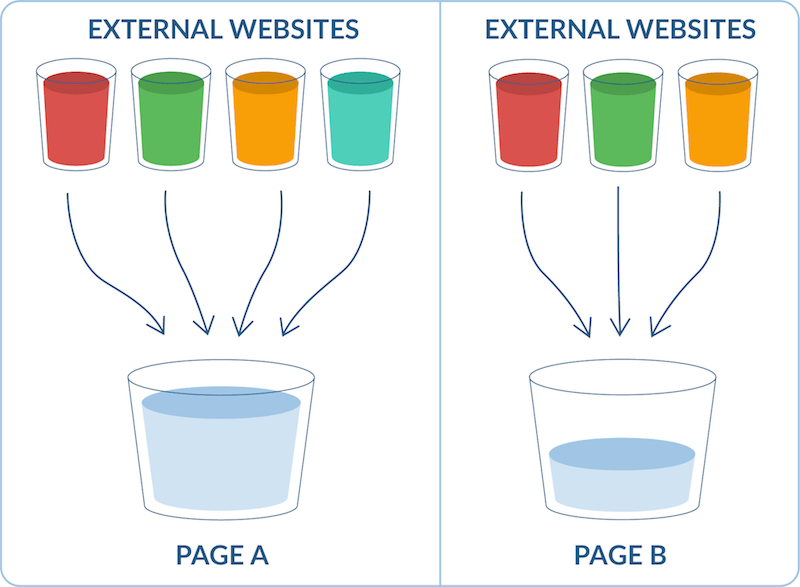
Source: Infographic courtesy of WooRank.
Blog Tip No. 9 – Link to Other Sites and Ask Them for Social Shares of Your Content
This has a two-fold effect.
Number one, when you link to other authoritative sites with content that is relevant to your own readers, it automatically increases the authority of your site.
Secondly, since most entities like receiving back links, there is a good chance that they would be willing to reciprocate and share your blog content with their social media followers.
Send them a communication sharing your blog content which contains a link to their company’s content, tell them you are an avid fan of their content and that you would be honored if they would share your post with their social media followers.
Depending upon the entity and the nature of your post, this may mean thousands of followers become aware of your content!
No guarantees, but may be well worth the effort even if only a small percentage of entities respond affirmatively.
Blog Tip No. 10 – Make Good Use of Graphics and Visual Content in All Your Posts
Similar to the way I used visual content above in Blog Tip No. 8, utilizing engaging graphics will help distinguish your content from similar content on the web and increase SEO.
Everything from photos, to illustrations, to charts, to graphs, to infographics, to embedded video clips – they should all be strategically incorporated into your blog presentations.
Blog Tip No. 11 (Bonus) – Average Length of Time to Read
According to a Science Direct article on reading speed, the average speed of an adult reading non-fiction content is 238 words per minute.
You may have noticed that some of the leading marketing sites will reference the length of time it should take to read one of their blog posts or studies, by posting the estimated time at the beginning of the text.
For example, they may format the text as follows:
What Is __________? | Author Name | Date | 11 Min. Read.
You can calculate the estimated read time of your own articles by dividing the total number of words in your article, by the average reading speed.
In other words, a 2,500 word article would take approximately 10 minutes to read on average [2,500 / 238 = 10.50].
Conclusion
Which blog tips do you find to be the most useful in your industry?
Have you previously incorporated any of the tips mentioned above?
If so, what were the results of same?
Feel free to leave a comment below.
If you have not already done so, please don’t forget to Subscribe in order to receive periodic updates on valuable digital marketing strategies delivered right to your e-mail inbox!
See you in the next blog post…

 Insightful Digital Marketing