

Table of Contents
- Key Takeaways
- Introduction: Keyword Research
- Basics of Keyword Research
- Are Your Webpages Relevant Enough to be Found?
- Keyword Stuffing: May Harm Rankings
- Three Main Types of Keywords
- Keyword Research – Professional Tips
- Keyword Research Tools
- Primary vs. Secondary Keywords
- Keyword Clustering
- Old School Keyword Research (100% Free)
- LinkedIn and Reddit: How To Use for Keyword Research
- Conclusion
Key Takeaways
- An outline of several free or “freemium” software programs;
- A wide variety of keyword research techniques used by SEO experts;
- Free research methods which are utilized by pros – but not by novices;
- Go from beginner to professional keyword researcher with a little practice;
Introduction: Keyword Research
All websites, blogs, and web content in general, should have their content optimized around specific keywords – supported by a competent SEO keyword research plan.
The results achieved from SEM (Search Engine Marketing), often referred to as pay-per-click (PPC) advertising, goes away once you stop paying for the PPC campaign.
The results achieved from a well-planned SEO or Search Engine Optimization campaign supported with competent keyword research, will theoretically last as long as your content remains relevant to visitors and search engines.
Basics of Keyword Research
Let’s clear up a myth right now – there is no single correct way to perform keyword research.
In its simplest form, keyword research should identify common terms and phrases that a person would normally use to locate information online about products, services, individuals, companies, governments, ideologies, etc.
Whether you’re using Google, Bing, Yahoo, Lycos, DuckDuckGo, Baidu or YouTube as your search engine, they all have the same common objective – to present a user with a range of related links (paid and organic results) that represent the most relevant information available.
YouTube is not often associated with other search engines by the consumer, but in reality, it is the second largest search engine in the world.
I included one of the original search engines, Lycos, on this list for nostalgia purposes.
It was the first search engine to ever go public, was the most visited online destination in the world during the late 90’s (before Google and Yahoo), and has a cool dog logo – named Lycos – which “fetches” information from the web.
Are Your Webpages Relevant Enough to be Found?
Google’s famous algorithm will decide what content is the most fulfilling to a searcher’s query.
If your webpage(s) contain the same keywords as a search query, you’re off to a pretty good start.
Sometimes people type in a single word query – and sometimes they type in multiple words to locate the information, or products, or services they are seeking.
Hopefully, their keywords either match or are similar to the keywords (or what I like to call keyphrases or key topics) contained on your webpages.
If the keywords used in a query appear in your headers, or in the body of the webpage itself, the algorithms will determine that your site is more relevant to the search query as opposed to less relevant.
The Google Search algorithms are interested in more than just a bunch of individual keywords – they want to see if your webpages contain phrases and topics that may interest a searcher.
If someone enters the keyword “golf” into the search window, Google presumes they are not interested in results that only include the word “golf” multiple times on the same webpage.
Instead, Google presumes that the person may indeed be interested in related topics such as “golf courses”, or “golf equipment”, or “golf apparel”, or “golf lessons”, or “world golf rankings.”
In addition, a searcher may not necessarily be interested in reading a bunch of text on a page, but may instead be interested in watching a video showcasing various “golf venues” around the world, or the searcher may want to see a series of photos showing various types of “golf artwork.”
Keyword Stuffing: May Harm Rankings
There are a lot of approaches and tools available to help with keyword research. However, there is one approach that is addressed in Google’s SEO quality guidelines as a great big no-no.
That practice is called “keyword stuffing.” Keyword stuffing occurs when a webpage is loaded down with the same keyword(s) with the objective being to manipulate the way in which a site is ranked in the search engine results.
These keywords oftentimes appear out of place, and don’t fit in with the natural flow of a webpage.
As far as Google is concerned, stuffing pages with keywords provides a negative user experience and can actually harm your site’s ranking.
If you have a local listing under the Google Business Profile platform, then stuffing unnecessary keywords into that listing may lead to action being taken which would result in a suspension of your local listing.
This keyword caveat would also apply to images and video content – such as alt text. You should instead focus on creating useful, insightful information that uses keywords appropriately, and in context.
Here are three (3) examples of keyword stuffing…
Example No. 1 – A boutique law firm in California that practices bankruptcy law wishes to be ranked by Google for providing services in multiple counties and cities.
So the firm simply includes large blocks of text at the bottom of each one of their webpages listing every conceivable county and/or major city throughout the state in alphabetical order – without any regard to context or natural language flow.
Example No. 2 – A local sporting goods store – hypothetically named ABC Sporting Goods – wants to be highly ranked by Google for selling “camping and hiking” products in their city.
In order to accomplish this, they repeat the same words and phrases over and over on a single page of their website, in different sentence structures.
“Our [name of city] store sells brand name camping and hiking products, and we carry the widest selection of camping and hiking equipment in the entire area. We feature weekly sales on our camping and hiking inventory. Our friendly and knowledgeable staff will be more than happy to answer all your questions about camping and hiking, so you can rest assured you purchased the right camping and hiking goods for your individual needs.”
Example No. 3 – Same sporting goods store has a Google Business Profile listing, which repeats those same word combinations.
“ABC Sporting Goods – Camping and Hiking Super Store, Expert Advice on Camping and Hiking, Widest Selection of Brands, Camping and Hiking Guides and Maps, In-Store Repairs on Camping and Hiking Equipment.”

Three Main Types of Keywords
Short-Tail Keywords
Generic in nature. They are typically two words or less in length – e.g., “Florida hotels.”
They typically result in high search volume, high competition for those keywords, and low conversion rates.
Individuals using these types of keywords are displaying informational intent, and are still at the awareness stage of the marketing funnel.
Medium-Tail Keywords
More specific. Generally comprised of three to four words – e.g., “Orlando versus Tampa hotels.”
They typically result in medium search volume, medium competition for those keywords, and medium conversion rates.
Individuals using these types of keywords are showing commercial or investigative intent, and are at the consideration stage of the marketing funnel.
Long-Tail Keywords
Normally very specific. They are typically four words or more in length – e.g., “Best summer hotel deals in Orlando Florida.”
They typically involve less search volume, less competition for those keyword combinations, and the best part, a much higher conversion rate than short or medium tail keywords would produce.
Individuals using these keywords are displaying transactional intent, are at the conversion stage of the marketing funnel, and are oftentimes ready to make a purchase – i.e., make reservations at a hotel property for their next vacation.
Generally speaking, there is an inverse relationship between Search Volume and Conversion Rates.
If you graph conversion rate & search volume, you will see the correlation between the use of long tail keywords and the total number of conversions.
The more specific the search terms, the higher the customer conversion rate tends to be – the less specific the search terms, the lower the customer conversion rate tends to be.
This infographic does a great job of illustrating this point:
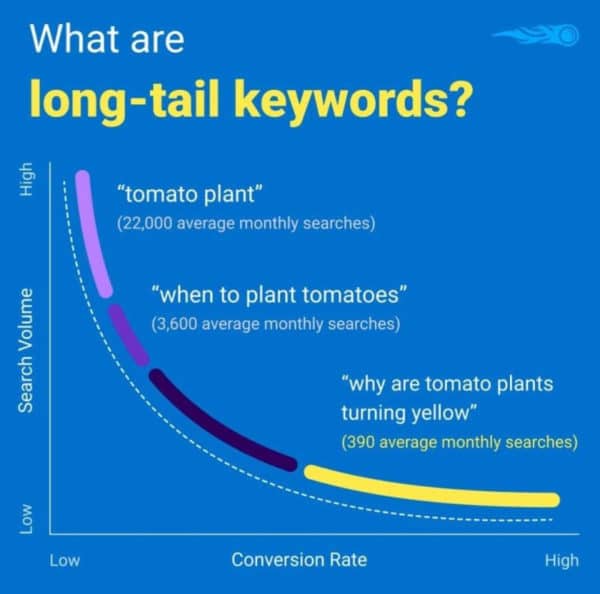
Source: Infographic courtesy of Semrush.
Therefore, a great goal would be to find a combination of keywords where the total number of people searching, statistically intersects with the total number of potential customer conversions.
Looking at the above graphic, that ideal intersection may be somewhere around the bottom half of the dark blue segment – above the yellow segment.
This is where the search volume remains decent, but the conversion rate (turning prospects into paying customers) is at a much more respectable level.
In summary, long-tail keywords increase both traffic and conversions for these main reasons:
- They are easier to rank for on the various search engines
- You are aiming at a more targeted audience – an audience that is likely to be ready to move forward with a purchase
- Search engine marketing or pay-per-click advertising will be more affordable for these keywords due to lower search volumes and lower competition
Keyword Research – Professional Tips
Maintain a keyword spreadsheet using Excel or Google Sheets to identify and create a list of keywords relevant to your business
Choose keywords that have high search volume, but are still relevant to your business
Pay attention to the commercial intent of keywords because it will be a harbinger or signal that the consumer is getting ready to convert to a paying customer.
Continuing with our example from above…commercial intent may be expressed by search queries as follows: “Compare room rates for hotels near Orlando Florida.”
Monitor your competitors and know how they are ranking for the same or similar keywords.
Subscribe to various online publications to stay up to date on search industry news (e.g., Search Engine Journal, Search Engine Watch, and Search Engine Land)
Note: In Google, entering “allintitle:Orlando Florida hotels” will show you all the search results with those keywords in the title tag.
This is what everyone normally sees on the SERPs (search engine results page) as they are scrolling through the organic listings.
You can insert any keyword or group of keywords in place of “Orlando Florida hotels”
Keyword Research Tools
Use keyword research tools whenever possible. Here are some of the most widely used tools…
Google Research Tools
Google Trends (Free – allows you to explore keywords, products, topics, etc. that are trending over time in Google search queries)
Keyword Planner (Free – available as part of a Google Ads account)
SaaS Research Tools
Ahrefs – Keyword Generator (Freemium)
MOZ – Keyword Explorer (Freemium)
NP Digital – Answer The Public (Freemium)
NP Digital – Ubersuggest (Freemium)
Semrush – Keyword Magic Tool (Freemium)
Primary vs. Secondary Keywords
Every web page should strive to contain primary keyword(s) and secondary keyword(s).
“Miami fitness club” (primary) could be supported with “24 hour Miami fitness club” (secondary) or “Miami fitness club spin classes” (secondary).
Keyword Clustering
SEO professionals recommend clustering keywords into themes that match the content on your webpages and the intent of search queries. For example…
Cryptocurrency Exchanges (Pillar Topic) can be clustered into sub-topics as follows:
- How do cryptocurrency exchanges work? (Cluster Topic);
- Are cryptocurrency exchanges regulated? (Cluster Topic);
- How to invest in cryptocurrency exchanges. (Cluster Topic);
- A step by step guide to cryptocurrency exchanges. (Cluster Topic);
- What are the most popular cryptocurrency exchanges? (Cluster Topic);
- Average returns for cryptocurrency over a 5-year period. (Cluster Topic);

Old School Keyword Research (100% Free)
LSI, or Latent Semantic Indexing, refers to keywords that are semantically linked to your primary keyword(s).
These linked keywords will lay a good initial foundation for you to continue expanding your research.
For example, I recently conducted a sample Google search for the keywords “San Diego CA DUI Attorney.”
When you do a search in Google for that topic you will notice three (3) very important keyword events or sections occurring on the search engine results page:
- Autosuggestions (automatically appear while typing Google query).
- Here are some of the phrases that occurred:
- “how to beat a dui in California”
- “do i need a lawyer for dui in California”
- “what happens when you get a dui in San Diego”
- Here are some of the phrases that occurred:
- People Also Ask (questions people commonly search on Google).
- Here are some of the phrases that occurred:
- “How much does a DUI attorney cost in California?”
- “Is it worth getting a DUI lawyer in California?”
- “How much does a DUI cost in San Diego?”
- “How long does it take to resolve a DUI?”
- “Is a DUI a felony in San Diego?”
- Here are some of the phrases that occurred:
- Related Searches (related searches performed by other people).
- Here are some of the phrases that occurred:
- “best dui attorney san diego”
- “free dui consultation”
- “dui lawyer”
- Here are some of the phrases that occurred:
Quora, a social question-and-answer website and online knowledge market, is another good alternative platform for identifying topics that are popular, and keywords that result in high search volume.
Wikipedia, a free online encyclopedia, can be yet another good free source of keyword research.
Pay attention to Wikipedia’s Contents section, the See Also section, the References section, the External Links section, and the Categories section in a Wikipedia listing – depending on the topic, these sections may or may not be fully populated with content.
LinkedIn and Reddit: How To Use for Keyword Research
Lastly, social media can be used to identify articles and discussions on specific topics that are followed or shared the most amongst its users.
I’ll be posting future blog articles on social media marketing in general.
I want to focus on keyword research as it specifically relates to these two social media giants – LinkedIn and Reddit.
Reddit, a social media platform, with its incredibly strong sense of community and large volume of monthly active users (430+ million at last count), is a great example of being able to tap into the collective conscious of a social media network.
Two more Reddit statistics: there were 1.7 billion visits measured during May 2022, and they currently have over 130,000 active subreddits (communities) – those represent a whole lot of potential marketing “focus groups.”
There is a keyword research tool called Keyworddit which will show you the average monthly search volume for a specific keyword(s) from subreddits with a minimum of 10,000 subscribers.
If you are searching on the largest professional networking site LinkedIn, the platform has a type-ahead feature which will predict or suggest terms as you are entering your keyword terms.
If you are seeking to attract new clients or customers to your products or services (like most businesses these days), or potential employers to your profile, you would want to be sure and add relevant keywords to the following sections of your LinkedIn profile:
Headline;
Summary;
Profile URL;
Skills section;
Company descriptions;
Profile picture file name;
Groups and associations;
Job titles and descriptions;
Articles and blog posts you author;
For example, if you are a litigation attorney at a large law firm that typically represents corporations and other organizations (such as non-profits) facing large scale legal action, you might incorporate keyword terms such as “class action defense”, “mass torts”, “antitrust litigation” and “regulatory compliance investigations”, just to name a few.
All of these will serve to increase your LinkedIn SEO (LinkedIn, like all major social media, is a potent search engine).
Use hashtags (#) in the social media articles you post – a hashtag is a searchable link which will improve your SEO on a particular social site.
Rule of thumb: a LinkedIn post should include no more than 5 hashtags, while Facebook & Twitter should be limited to 2 or 3 hashtags.
Lastly, hashtags should be in the form of Camel Case (e.g., BestCaliforniaLawFirm) to optimize web accessibility.
More people will discover your posts if you make good use of hashtags, which can lead to more client or customer leads!
For example, using the litigation attorney hypothetical above:
#LitigationAttorney;
#InsuranceLitigation;
#SecuritiesLitigation;
#EnvironmentalCompliance;
Whenever you are integrating keywords into your profile, be certain to make sure the words flow naturally, you are not “stuffing” terms (as discussed above), and the keywords are spread as evenly as possible throughout your profile.
Following these guidelines will help your professional profile come across as – well – professional!
Conclusion
What is your favorite keyword research technique(s) covered in this article?
What keyword techniques have you incorporated into your business?
Feel free to leave a comment below.
If you have not already done so, please don’t forget to Subscribe in order to receive periodic updates on valuable digital marketing strategies delivered right to your e-mail inbox!
See you in the next blog post…

 Insightful Digital Marketing