

Table of Contents
- Key Takeaways
- Introduction: Social Media (Part 1)
- Main Benefits of Social Media Marketing (SMM)
- The Five Pillars of SMM
- Three Main Types of Social Media
- Social Media Marketing Funnel – 4 Key Stages
- Key Social Media Marketing Goals
- Defining Your Social Audience
- Best Ways to Use Social Media Platforms + Pro Grade Tips
- Choosing the Right Social Media Platform
- Building Your Brand Identity on Social Media
- Conclusion
Key Takeaways
How you can use social media to…
- Increase brand awareness;
- Strengthen customer relationships;
- Drive traffic to your website and blog;
- Create a powerful lead generating resource;
- Gain useful insights about your competitors;
In addition, we will be covering…
- Discovering the most profitable ways to use social media;
- The key stages of the marketing funnel on social media;
- Building a memorable brand identity on social media;
- Professional grade tips you can apply immediately;
- Real brand examples of leveraging social media;
- How to set key marketing goals and objectives;
- Defining your target audience and persona;
- 4 main types of social media platforms;
- Choosing the correct social platform;
- Establishing your brand’s “voice”;
Introduction: Social Media (Part 1)
Does your company have a social media marketing strategy in place? Over 4 billion people were using social media in the year 2021 – it is now projected that by 2027, there will be 6 billion social media users.
The entire world population today is slightly under 8 billion.
Would you like a straightforward but effective way to build your brand, establish a loyal customer following, and increase your profitability?
I will breakdown below, how this can be accomplish through social media marketing.
Social media usage is clearly one of the most popular activities that people engage in these days, and is essentially any digital tool that allows an individual to create, share, “like”, comment, “follow”, and subscribe to content, publicly.
Platforms from Facebook, Twitter, YouTube, and Instagram to LinkedIn, Reddit, TikTok and Pinterest, are used by people to keep in touch with friends and family, share memories, exchange photos and videos, conduct product research, track current events, locate sports and entertainment content to enjoy, and ferret out service providers.
Social media enables a marketer to reach the maximum number of consumers in a cross-section of different ways.
This two-part blog series will focus on the essence of how social media marketing functions.
Main Benefits of Social Media Marketing (SMM)
The overarching benefit of social media is that it enables marketers to connect with the consumer and help them to better understand the brand itself, as well as the people behind the brand – in other words, the backstory of what makes the company tick.
In addition to establishing genuine connections, the following key benefits are why social media has become such an effective arrow in the marketing quiver of companies worldwide:
A great method for increasing brand awareness – How familiar are people with your brand, or company in general?
A lot of people these days first discover brands and companies by nothing more than a social media post from a previously unknown brand which happened to catch their attention.
Someone in their network may have shared the information, or it showed up in their organic news feed.
According to a Pew Research study, 70 percent or more of Americans use social media to connect, engage, and share information with each other. The same study cited social media use as a daily routine.
Social media helps strengthen relationships – One of the most, if not the most important things that a company can do, is to build trust between itself and the users of its products and services.
Social media allows entities to reach out and become problem solvers, and display to their customers that they really care about their needs and opinions.
It also enables companies to show that they share and support a common vision with their customers (e.g., environmental sustainability and social justice reforms) – which in turn builds the aforementioned characteristic of trust.
Drives increased traffic to your website or blog – Posting and sharing content on social media platforms has a direct correlation to the number of people who ultimately visit your web content.
The simple act of including your website and/or blog address in your social media profiles provides people who wish to learn more about your company, with easy access to do so.
A powerful resource for generating leads – Simply put, a lead is a potential customer, and leads can be converted into paying customers.
Anyone who takes a specific action such as subscribing to an e-mail newsletter, signing up for a free trial, or downloading a case study, is one step closer to become a full-fledged customer.
Social media platforms oftentimes provide advertising formats specifically designed for lead collection.
A company can also direct customers to their own customized, standalone landing pages, which are normally built for the sole purpose of collecting leads or converting those leads into paying clientele.
Gain insights to inform marketing strategy – Social media is one of the best ways to collect analytical data to help inform your paid or organic marketing campaigns.
You can measure what your target audience likes and dislikes, as well as their lifestyle interests. This in turn can help inform your marketing strategy – and make it possible to alter same, on the fly, if necessary.
Once you start posting on social media outlets, an array of analytics tools becomes available to you as a content creator.
LinkedIn, for example, calls this status “Creator Mode”, which will give you the ability to track everything from total impressions, to the names of engaged companies, to the professional roles of individuals interacting with your post.
Learn about your competitors – Analyzing a competitors’ online activities can help you discover what is working for them, and guide you through ways that you can improve upon what is not working.
Cost-effectiveness – First of all, create a profile on social media is free. Secondly, segmentation based upon demographic information, as well as personal interests and hobbies, makes it possible to aim at a very specific audience avoiding any unnecessary spending on a wider audience.
Businesses from the individual entrepreneur working off their kitchen table, to multi-national corporations, can derive benefits from a presence on social media. Social media is now an indispensable part of a company’s business development strategies.
The Five Pillars of SMM
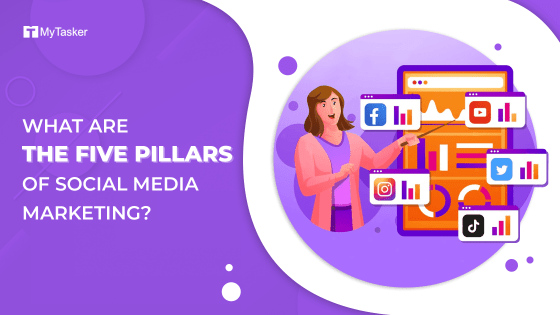
Source: Infographic courtesy of MyTasker.
Pillar No. 1 – Strategy
An effective strategy should be the first pillar erected towards building a successful social media marketing campaign; this will spell out the primary goals of your campaign.
Examples of primary goals would be raising brand awareness, promoting customer loyalty programs, increasing website traffic, and building customer referrals.
Your social media campaign would be contingent upon your overall marketing goals, which would be contingent upon the broader goals of your business.
Which social media platform(s) you choose will be dependent upon where your target audience spends the bulk of their time.
- If you find your target audience to be Gen X, then platforms like LinkedIn and Facebook would be more appropriate.
- If you are targeting the Millennial demographic (Gen Y), then your best bet would be a platform like Instagram.
- If you are targeting Gen Z, then you would want to focus on a platform like TikTok.
- YouTube would be an example of a platform that crosses over multiple demographics.
The key is to determine the type of content your audience values the most and where they go to obtain that content. Some may prefer content that is inherently educational, while others simply want to be entertained.
An additional consideration will be the format of the content you post – such as images, videos (short or long form), articles, and infographics.
Pillar No. 2 – Planning and Publishing
Having a consistent presence on the various platforms – the operative word being consistent – enables a brand to maximize its exposure to potential customers.
There are automated scheduling tools that can be subscribed to on various marketing SaaS platforms such as Hootsuite and Sprout Social, to help you schedule posts in advance.
This will ensure your content gets disseminated regularly, and that you are publishing content most likely to attract your target audience.
In addition to the days of the week and the time of the day, you’ll also need to consider frequency.
Here are some questions to ask as guidelines, as well as some additional resources:
- What days of the week and times of each day, is your audience most likely to engage with your content?
- How frequently should you post – multiple times a day, once a day, every other day, only on certain days of the week?
- You want to be top of mind, but at the same time, you should avoid overwhelming people’s feeds.
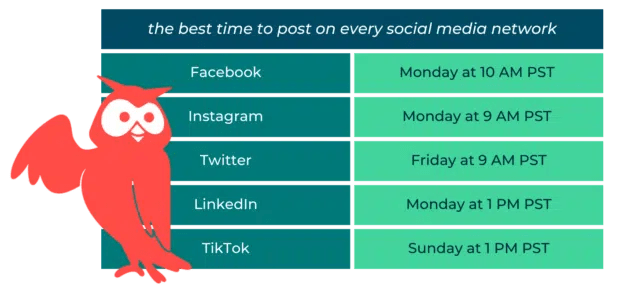
Hootsuite conducted a recent study of the best times to post on social media, where they analyzed an audience of roughly 8 million followers to determine what was working the best.
Creating a social media calendar – even if it is just a basic calendar that you use as part of your web-based email program – will help you keep track of and plan the distribution of your content.
Hootsuite also recently engaged their social media teams and some outside experts for guidance as to how frequently to post on social media.
The results reported on a per platform basis for 2023, were definitely an eye-opener.
Here are summaries of the best overall times to post on social media, and the best frequency for posts on social media:
- Facebook: Post 1 to 2 times per day.
- Instagram: Post 3 to 5 times per week.
- Instagram Stories: Post 2 times per day.
- Twitter: Post between 2 and 3 times per day.
- LinkedIn: Post between 1 to 2 times per day.
- TikTok: Post from 3 to 5 times per week.
- Pinterest: Post at least 1 time per week.
- Google Business Profile: Once a week.
Sources: Infographic and data courtesy of Hootsuite.
Note: By the way, an effective post does not always mean a 2,000-3,000 word blog article. Recent studies have shown that quality blog content that is shorter in length, can still rank well on Google.
Social media posts can, and should, include a cross-section of content, such as the following:
- Short-form video;
- A research template;
- A colorful infographic;
- A downloadable case study;
- A survey or poll of your followers;
- A breaking news story about your industry;
- An invitation to attend or register for an event;
- A press release announcing a new product/service;
Don’t forget to include a reasonable number of relevant #hashtags (e.g., 3 to 5) in all your interactions from original posts, to the “likes” and comments about your customer’s posts.
Pillar No. 3 – Listening and Engagement
Your following on social media will naturally increase the more you share content, and the more you engage with customers.
As social media users mention your brand, comment on your posts, and tag you in their own posts, you will want to begin incorporating Social Listening.
Social listening is the art and science of tracking and analyzing engagement as it relates to your brand.
Discovering what people think about your brand can provide valuable insights for your marketing and product development.
Pillar No. 4 – Analytics and Reporting
As addressed in-depth by a blog post on analytics, the science of analytics is the process of collecting data and performing analyses of that data to inform your marketing and overall business decisions.
This is oftentimes done on a daily or weekly basis, comparing one period against another period.
Many social media platforms provide their own built-in analytics and reporting tools.
This data can in turn be memorialized into a social media report which can be shared with stakeholders, including recommendations for adjustments or improvements to a social media campaign.
Pillar No. 5 – Paid Social Media
I have discussed the main differences between organic and paid media in other blog posts. Most of your social media marketing will be centered on organic (non-paid) content.
However, paid social media can be a great complement to your organic content.
Paid media gives you more control in terms of targeting your message.
You may also use data gathered from organic social media campaigns to help guide and inform your paid social media campaigns.
Three Main Types of Social Media
Earned Media
Customer generated content, positive and negative, is all considered earned media.
A share by one user to another (or to an entire group), posts on a social media timeline, and product/service reviews, are all examples of earned media.
Social media is one of the most powerful mediums for generating earned media. User-generated content, or UGC, is any content that is not created by a brand, but is instead created by the brand’s clientele or customers.
Entire marketing campaigns have been centered on UGC.
For example, Gymshark, a popular brand of fitness wear that resonates with Generation Z, has encouraged their loyal customers to post UGC on TikTok sharing their fitness goals and transformation progress.
Using certain branded #hashtags (e.g., #gymshark66), the winners of these hashtag challenges would earn a chance to be awarded a free years’ supply of Gymshark products.
One such promotion led to 1.9 million “likes”, over 12,000 comments, and 45.5 million views – talk about viral marketing!
Owned Media
This is content fully controlled and created by a brand.
Websites and blogs are one of the most common forms of owned media. A social media profile is another great example of this type of media.
You are able to control the flow of information surrounding your brand.
When your brand owns a media property, it determines what type of posts to publish, the frequency of same, and how the public will be allowed to interface with the posts (e.g., you may disable public comments or disallow user generated content with external links).
Effectively promoting your owned media can also lead to earned media.
Paid Media
Any form of digital promotion paid for by a brand.
Examples would include Facebook ads, YouTube video spots, and Influencer marketing.
The main advantage – your brand is able to raise awareness amongst customers who are not actively searching for your specific brand, but who are interested in the types of product and services you offer.
Paid social media can also be the catalyst which drives more earned media and internet traffic to your owned media.
Note: Community forums can cross over into both earned and owned media.
A company moderated forum would be an example of owned media, while a forum maintained by a platform like Reddit would be an example of earned media.
Earned, owned, and paid social media should all be incorporated into an effective mix designed to improve brand awareness, generate leads, increase sales, and create a loyal following amongst your customer base.
Social Media Marketing Funnel – 4 Key Stages
The traditional marketing funnel is a visual representation – a type of road map you can follow – to better understand the process people go through from first becoming aware of your product or service, to ultimately becoming a loyal, repeat customer.

Source: Infographic courtesy of Sprout Social.
Awareness Stage
The first and arguably the most important stage, is when potential customers initially learn about your brand.
You want to capture people’s attention, ensure they remember your brand, and encourage them to learn more about your products and/or services.
This can be accomplished in a variety of ways – using keyword clusters or topics your research shows is important to your audience, you can create content marketing materials that can be shared on various social media platforms.
This may include blog articles, videos, infographics, case studies, e-books, and newsletters, to name a few.
Consideration Stage
Your potential customers are now seeking more data and information about your company to assist them in determining whether or not they will convert into a paying customer.
This is where materials such as customer reviews, product comparisons, company history, case studies, and product tutorials can help build further trust and confidence in your brand.
Note: In the marketing industry, there is a special rule known as the “Rule of Seven” (i.e., a potential customer must be exposed to the same message at least 7 times, before they are ready to make a buying decision).
That’s why social media can be so highly effective at moving people along the purchasing journey – every time you appear in someone’s social media feed you are making them that much more familiar with your brand!
Once you have courted the relationship on social media and the individual has taken a proactive step such as “following” your company or signing up for a training course, you know they are much more interested in what you have to offer.
Conversion Stage
A prospect is finally ready to commit to your brand.
You might utilize paid re-marketing campaigns to re-connect with people in order to nudge them towards a purchase.
Re-marketing is also referred to as retargeting – a strategy that incorporates paid ads to target customers who have already visited your website, app, blog or social media page.
This is also the stage when you would offer special incentives such as discounts, in-store assembly, lifetime warranty, free shipping and delivery, a no-hassle return or exchange policy, and a money-back guarantee.
Loyalty/Advocacy Stage
This stage is so crucial to businesses in large part because the cost to acquire a brand new customer is actually five times higher than the cost to retain a loyal customer.
That is why businesses small and large have placed such an emphasis on customer loyalty programs – which are designed to nurture relationships with existing customers and create a sense of belonging to a community.
This is also the stage that your customers oftentimes become brand advocates for your products or services – and engage in good old fashion word of mouth advertising!
Customer loyalty programs are also a perfect environment to offer member-only purchase incentives.
Social media re-marketing advertising is another excellent way to reach back out to your existing customers and persuade them to make repeat purchases.
Creating a sense of brand community is also a great byproduct of marketing on social media.
For example, the fashion brand SHEIN, the most downloaded shopping app in the United States (2020), offers an affiliate marketing program for UGC or User Generated Content.
Loyal customers are encouraged to share pictures or videos of Shein purchases being worn on social media platforms, such as Instagram and TikTok.
This has proven to be a highly-effective marketing strategy for the company.
This fosters a sense of belonging to a community, and provides further social proof of customer satisfaction in the minds of potential customers, who see actual people wearing and enjoying SHEIN’s products.
SHEIN is a brand that targets and attracts Generation Y (Millennials) and Generation Z buyers with their affordable pricing model, cutting-edge styles and user-friendly e-commerce experience.
They currently ship their products to over 220 countries and regions around the world.

Key Social Media Marketing Goals
Here are some of the most common social media marketing goals measured by digital marketers:
- Build brand awareness;
- Managing brand reputation;
- Sales and prospective lead generation;
- Increasing overall community engagement;
- Enhance website and blog traffic across all platforms;
- Gain valuable customer and competitive insights for marketing;
Your overall business goals will determine which social media marketing goals you should prioritize.
The social media marketing goals should also be in alignment with your company’s overall marketing objectives – which will make it much easier to show the value and worth of your social media campaigns to stakeholders.
Defining Your Social Audience
Your social or target audience are the consumers who are most inclined towards using your products or services – and the ones most interested in paying attention to your social messaging content.
The main components which make up your ideal social audience can be defined as follows:
- Demographic Information – age, stage of life, and generation identity – is your audience comprised of teens, younger adults, single parents, retirees, etc.?
- Location – in what geographic regions do they make their residence?
- Language – what are the predominate languages spoken by your target audience?
- Interests – what are their passions, what do they care most about (e.g., political activism), and what do they enjoy doing away from work?
- Needs – what problems or issues have your customers been grappling with that your product or service may help resolve? Gaining an understanding of the information consumers search for online will create a better understanding of your target audience, pinpoint their needs more effectively, and provide insight into how you might engage them on social media.
- Social Listening – this is a technique used to track your social media platforms for mentions and conversations about your brand. You will learn good or bad, how your audience feels about your products and services, and what content they are sharing with others!
Best Ways to Use Social Media Platforms + Pro Grade Tips
Specific social media platforms will be more in keeping with your brand’s image than others – if your company happens to be on 12 different platforms concurrently, you will need to tailor your content for each individual platform.
Monthly active users (the number of unique visitors during a one-month period) is a very important concept to pay attention to on the various social media platforms, as this will inform where your brand should place its priorities.
The website Statista maintains stats on the most popular social networks worldwide, ranked by number of monthly active users.
Here are the four (4) most common types of social media platforms being utilized around the world:
- Social Networking – Facebook and LinkedIn are great examples of this genre since they allow users to interact with each other. These sites are used for both personal and professional reasons.
Pro Grade Tip: The real advantage of these social networking platforms is that they are a catalyst for users to share content.
If your company maintains a page for your brand (all business owners should strive to have a branded page), try to keep your content reasonably updated on a daily basis – the fresher, the better.
- Blogging/Microblogging – the definition of blogging is self-published content that exists online. Microblogging is simply a scaled-down version of blogging.
Twitter and Reddit are good examples of micro blogging platforms, while WordPress is a good example of a standard blogging platform.
Pro Grade Tip: Twitter users can find tweets on any topic they wish to discuss – company brands should use the “trending” section of Twitter to hone in on content being currently addressed by other users, and decide how much they wish to weigh in on the conversation.
Likewise, company brands should track the “web chatter” on Reddit and join in on Subreddits (niche communities within Reddit) that relate to their products and services.
- Photo Sharing – Instagram and Pinterest are great examples of this type of platform. You may choose to host your own visually-appealing content, or engage with content posted by others. These platforms are ideal for sharing photos, which are a great way to keep consumers engaged in your brand.
Pro Grade Tip: Instagram allows brands to post photos, then link their product pages directly in the photo so users can make purchases from the app. Pinterest allows brands to link directly to product pages right from the captions and replies.
You don’t have to link to product specific pages only – you may want to link to a website’s homepage or a specific landing page where the consumer can sign-up for a monthly newsletter or download an e-publication, as examples.
Pro Grade Tip: Users on these photo sharing sites are able to save content posted by other accounts.
If you are an account manager, these are valuable analytics which help track what content your audience is showing the most interest in saving, and what content you should continue to promote as a result of this feedback!
Video Sharing – Users can upload and share video content, and stream their own live content. YouTube and TikTok are great examples. These are typically broken into long-form such as YouTube content, versus short-form such as TikTok content.
Videos can encompass educational “how-to” content, behind-the-scenes content, entertaining content, social/environmental awareness content, and so much more.
Instagram Live and Facebook Live can be used to stream live content – such as a webinar or question and answer forum. This can be very useful for communicating to the public who you are as a brand, and what you stand for as a brand!

Choosing the Right Social Media Platform
Posting on the correct platform(s) will ensure you are targeting the right audience, and will maximize the traffic potential to your website.
There are now over 100 social media platforms worldwide – so which platforms should you choose to market your brand?
This will depend upon your target audience, the goals of your marketing campaign, your brand identity, where your competition is posting, and your overall resources.
Let’s take a look at some of the major social media platforms and what may drive you to choose one versus another for your marketing:
- Twitter – great for posting real-time information or “breaking news.” Its 280 character limit is ideal for disseminating very succinct content, and interacting with people in real time.
- Facebook – has the most active monthly users, and is good for posting content which does not need to be communicated as events are unfolding.
- TikTok – if your target audience falls into the Generation Z category (age of 25 years and under), then this is the platform for drawing in that younger demographic.
- LinkedIn – a dynamic platform where professionals from around the world can seek jobs, network with each other, exchange ideas, share learning experiences, join groups promoting certain professions, and create a following.
If brand authority, for example, is one of your marketing goals, LinkedIn would be a great platform in which to promote that objective.
- Instagram – an individual in the visual arts industry (e.g., graphic designer, interior decorator, and professional photographer) would benefit from this highly visual channel.
- YouTube – an entity that produces long-form educational and training videos – such as a major university – would benefit most from this platform.
Building Your Brand Identity on Social Media
Establish a Brand Position Statement
You should first establish an overview of what your company does, for whom, and what makes you different from the competition.
In order to create a brand statement, you will need to identify the following:
- Your audience;
- Customer challenges;
- Your company’s name or brand;
- Your products, services, or a differentiator;
- Your company’s or brand’s mission statement;
A Brand Position Statement Template
For [audience] who [customer challenge/need], [Company Name] provides [product and differentiator] because [brand promise or mission].
Exemplar Statement
“Our new social media network service titled PadKonex is specifically designed for the professional office worker who has been spending the majority of their working hours in a remote or telecommuting environment, due to shifting workspace and staffing expectations.
The WFH (Work From Home) Company, Inc. provides a secure, user-friendly SaaS platform that workers can sign up for and use to collaborate with co-workers, clients, vendors, etc., because our company’s mission is to create a comprehensive, safe, and productive platform so individuals can continue to work from home and still remain valuable assets to their company.”
Ensure Consistent Colors, Logo, and Imagery
A brand has to have consistency so people know immediately that a particular color palette, font style, logo design, and digital image belongs to your company.
Your social media pages should reflect this standardization, and should be visually appealing to your audience across all platforms.
Affiliate w/ Influencers Who Echo Your Identity
Influencer marketing can be a very powerful method of raising brand awareness, generating interest, and converting prospects into buyers.
Collaborating or partnering with the right influencer means you are choosing someone whose brand is in alignment with yours.
Create a “Voice” For Your Brand
Similar to the color scheme and logo design for your brand, social media users should be able to identify a post by your company based on the tone of your brand’s voice.
If your voice is normally humorous or funny in nature, then you should stick to this same tone throughout your social posts.
You will throw your audience off if you change from a humorous tone, to a more dark or serious tone for example, without any justifiable reason.
Your brand’s voice should be reflected in the captions and main body of your posts, as well as the text you use in graphics, videos, photos, and other visuals.
Conclusion
In the upcoming Part 2 of this series on social media marketing, we continue our discussion on branding, outline the various types of social media, highlight industry-leading software tools, address the art of social listening/engagement, and discover how to effectively design and “repurpose” your social media content.
What types of social media marketing have you incorporated into your business? Which platforms have worked the best for your particular product or service?
Given the social media trends, are you planning to devote more time in the future to marketing on social media? Have you established a clear and concise brand identity for your company?
Do your customers immediately recognize your brand based upon its logo and/or color scheme? What tone of voice has your brand adopted?
Feel free to leave a comment below.
If you have not already done so, please don’t forget to Subscribe in order to receive periodic updates on valuable digital marketing strategies delivered right to your e-mail inbox!
See you in the next blog post…

 Insightful Digital Marketing