

Table of Contents
- Key Takeaways
- Introduction: SEO Link Equity
- Link Equity Definition
- Why Internal Links Matter
- The Main Criteria for Internal Links
- How Much Link Equity Gets Passed?
- Why External Links Matter
- The Main Criteria for External Links
- Building Link Equity with Anchor Text
- Conclusion
Key Takeaways
- The definition of link equity or link juice in digital marketing;
- Why internal links and back links play such a vital role;
- How to quickly decipher “good” ones from “bad” ones;
- The best way to format your content and anchor text;
- Leading software tools for link building success;
Introduction: SEO Link Equity
When first starting out in SEO, the concept of link equity or link juice can be confusing.
Why is it so important to integrate internal and external links into an overall SEO plan?
What effect does it have on SERP or search engine results page rankings?
Link Equity Definition
Link Equity, also referred to as “Link Juice” in the digital marketing industry, is the process of an authoritative webpage or website – e.g., ESPN.com “passing on” some of its own equity to another webpage or website, by establishing a direct link from itself to the other site.
This linkage should be accomplished through descriptive anchor text (the linking portion of text) that is relevant to the topic being discussed.
If you are addressing statistics about artificial intelligence (AI), SEO, and referencing a study, for example, your anchor text should read along the lines of “the 2024 Study on the Impact of AI on SEO.”
Why Internal Links Matter
They help you establish topical authority on subject matters that are important to your target audience.
Internal links are hyperlinks on your website, that allow a visitor to move from one page worth of content to another page worth of content, while remaining on your website domain.
E.g., “About Us” and “Office Locations” and “Customer Reviews”
Google (and other search engines) treat these links like a roadmap to help locate and understand the structure of your site.
When used properly, internal links can actually send page authority (aka PageRank) to other pages on your website leading to higher SERP rankings.
The Main Criteria for Internal Links
Have at least 3 – 5 internal links pointing to other pages on your website or blog from your most important, and most content filled pages.
Make sure the anchor text is relevant to the content being linked.
A good rule of thumb – 3 links for every 1,000 words of content.
Internal links may be strategically placed on webpages as follows:
- In the header;
- In the body;
- In the footer;
- In a dedicated area (e.g., “Quick Links”) such as a bottom sidebar;
Keyword Clustering
This is often referred to as the “pillar page” or “hub and spoke” model, and is one of the most effective ways to link your internal pages for maximum SEO results.
You essentially start with one main page (pillar) devoted to a topic, and then create several other pages (clusters) that address subtopics, and logically link back and forth to the main page.
Example…
Pillar Page: SEO Search Intent, with summary sections addressing each of the following linked pages:
- Cluster Page 1: SEO Search Intent: Why It Is So Important
- Cluster Page 2: The Best Software Tools for SEO Search Intent
- Cluster Page 3: How to Dominate SERPs with SEO Search Intent
- Cluster Page 4: Keyword Research Methods for SEO Search Intent
- Cluster Page 5: What SEOs Understand Least About Search Intent
Your website or blog can (and should) have multiple pillar / cluster page combinations, addressing a variety of topics that match the search intent of your ideal customer profile.
Note: Descriptive anchor links from each of the summary sections on your main page should be pointing to the appropriate linked pages, and vice versa.
You should also consider creating internal links between each of your linked pages, that have a logical connection.
How Much Link Equity Gets Passed?
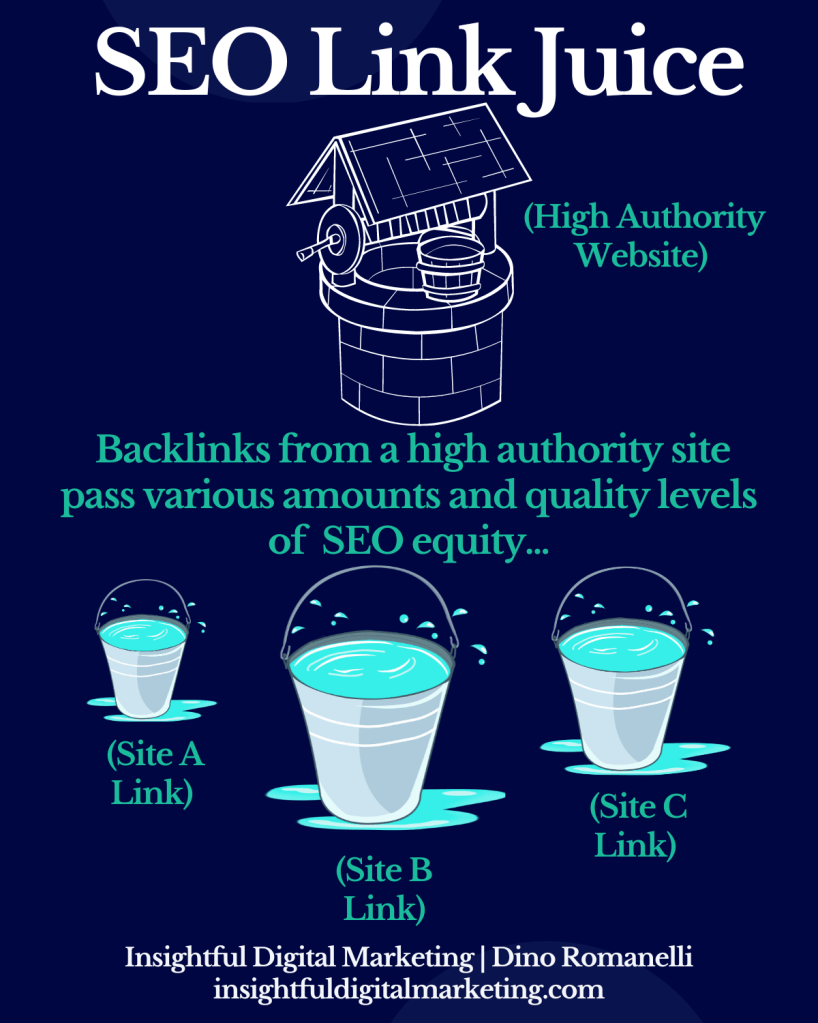
Link equity indicates the relative authority or strength of a backlink (see discussion below on Inbound vs. Outbound external link practices) – but how much of that authority is actually transferred to another website?
Well, the precise amount (and quality) of SEO equity that is passed from one page to another page will vary – sometimes dramatically!
Equity distribution is highly dependent upon the following types of factors:
- What’s the PageRank or URL rating of the referring page?;
- A link from a high DA site like Forbes is not very useful if the referring page is buried deep in the site architecture, with a low page rank.
- Check the topical authority or trust of the linking website;
- How relevant is the linking page’s contents to the linked page?;
- Google may penalize you for backlinks from high authority, toxic sites;
- Anchor text on a linking page that’s not relevant enough, passes less equity;
- How many outgoing links exist? More outgoing links = less equity per page;
- A backlink from a diverse topical source, will carry more equity to your site;
- What type of baclink are you acquiring? Editorials (PR), Guest Posts, and Business Listings (legitimate ones) create more overall equity;
Why External Links Matter
There are two (2) main types of external links…Inbound and Outbound.
Each one has its own unique way of contributing to your overall SEO success.
Inbound – Backlinks
When it comes to SEO success, backlinks are still considered the number one ranking factor. Why? Search engines considered them to be “votes” for your content.
Simply speaking, backlinks are links from other websites that point at your website; the more high quality and relevant backlinks you have, the more trust the search engines will place in your website.
SEO is the most effective inbound marketing strategy, because the intent of the searcher is front & center.
Outbound – “Reverse” Backlinks
While obtaining links (from other high-quality, relevant websites) is important, you may proceed right away to create your own outbound links to high quality, relevant sites.
Note: Be careful not to start linking to other high-authority sites (e.g., Quora and Wikipedia) with the sole intention of boosting your rankings.
Google has confirmed in a discussion on link best practices, that if you are going to create outbound links, those links should follow this general criteria:
- Include descriptive enough anchor text so that Google and your users can understand the content being linked;
- The content being linked to should be relevant to your site’s users;
- Your site’s users should receive additional value from the content being linked;
In other words, a Gardening Blog (which discusses everything from soil preparation to grooming) should not be linking to ESPN (the worldwide sports network) for the exclusive purpose of obtaining credibility.
The following parameters should be kept in mind when linking to external sources:
- Search engines will give your site credit for linking to information that is considered valuable to a searcher and matches their perceived intent.
Note: You may use the Google Search Console as well as Google Analytics (GA4) to review the status of backlinks as they relate to your site, as long as you have added your property (website) free of charge to each of these platforms.
The Main Criteria for External Links
We will not be covering external link building methods in this article, because that subject justifies an entirely separate blog post or posts.
However, the primary criteria you want to follow when establishing external links is as follows:
- Have at least 3 – 5 external links pointing to pages not on your website or blog (outbound).
- Make sure the anchor text is relevant to the content being linked (inbound and outbound).
- A good rule of thumb – 3 links for every 1,000 words of content (outbound)
- The other sites you link to should have content that’s relevant to yours (inbound and outbound).
- The other sites are real, legitimate sites, with organic search traffic (inbound and outbound).
- The other sites are deemed authoritative, with high quality backlinks (inbound and outbound).
Note: You will normally have complete control over the structure of outbound links from your site to other sites, but will likely not have as much control over inbound links coming from other sites to your content.
Nonetheless, when you reach out to other websites for purposes of linking back to your own website or blog, be sure to ask them to incorporate specific anchor text – that is descriptive.
You may use free software such as Semrush’s Backlink Analytics tool or Ahrefs’ Backlink Checker tool to help determine the authority level of various domains.
Building Link Equity with Anchor Text
There are multiple types of anchor text that can be used in distributing link equity or link juice.
Some formats will help your SEO, while others may actually harm your SEO.
I am going to focus on four (4) anchor text styles that I would recommend, two (2) that I would not recommend, and one (1) style that I would caution against using (unless you have experience with HTML or CSS).
Exact Match
Recommended – This type of anchor link precisely matches your keywords, and aligns with the content on the page that is being linked.
Example: Keyword = “Hawaiian vacation” | Anchor Text = How to plan a “Hawaiian vacation” in 24 hours.
Partial Match
Recommended – This type of anchor link includes a modification of your keywords, usually by adding other words for context.
Example: Keyword = “Hawaiian vacation” | Anchor Text = Here are the 10 most popular “Hawaiian vacation packages” which include airfare, hotel, and daily guided tours.
Branded
Recommended – This type of anchor text is centered around the name of a brand or a brand’s slogan.
Example: A company like “United Airlines” would use its own name as the anchor text, or its iconic slogan, “Fly the Friendly Skies.”
Branded + Keyword
Recommended – This method combines a company’s branded name with another keyword or keywords, to create a descriptive anchor link.
Example: Keyword = “United Airlines” + “Frequent Flyer Miles” | Anchor Text = Take advantage of “United Airlines’ Double Frequent Flyer Miles” for all major destinations in the Hawaiian islands between June 1st and August 31st.
Generic
Not Recommended – This type of anchor includes no supporting keywords and can create confusion in the minds of a reader, as well as search engines. It oftentimes forces a website or blog visitor to have to decipher the nature of the information being linked.
Example: Keyword = “United Airlines’ Carry-On Policy” | Anchor Text = “Click Here” or “Learn More” or “This Page“.
Naked or URL Only
Not Recommended – This anchor is just the raw URL, the way it would appear at the top of your web browser window. May come across as sloppy to some readers, as well as create confusion.
Example: Keyword = “United Airlines’ Carry-On Policy” | Anchor Text = “https://www.united.com/en/us/fly/baggage/carry-on-bags.html“.
Images
Use With Caution – This anchor text is embedded into an image or infographic, for example. You are essentially using the “alt text” of an image as your anchor text.
These types of anchor links may not work all the time, depending upon your CMS (Content Management System), and the web browser you are using at the time.
You may also need to be familiar with the HTML or CSS languages to adequately troubleshoot any problems.
Example: Keyword = “Hawaiian vacation” | Anchor Text = “Sunset photo off the coast of Maui during Hawaiian vacation“.
Conclusion
What types of link building practices do you incorporate at your company? Have you found certain link building techniques to be more effective than others?
Feel free to leave a comment below.
If you have not already done so, please don’t forget to Subscribe in order to receive periodic updates on valuable digital marketing strategies delivered right to your e-mail inbox!
See you in the next regular blog post…

 Insightful Digital Marketing