

Table of Contents
- Key Takeaways
- Introduction: E-Commerce (Part 1)
- How Do You Define E-Commerce and How Does It Work?
- What Types of Products or Services Can Be Sold Online?
- The True Benefits of Selling Online
- Common Terminology Used in the E-Commerce Space
- E-Commerce Strategy Guide – Six Essential Elements
- A Preview of the Upcoming Part 2
- Conclusion
Key Takeaways
- Strategies for marketing to Gen X & Gen Y (the largest online shoppers);
- How to lay a solid foundation to prosper in e-commerce;
- What types of products or services can be sold online;
- Terminology used in the e-commerce industry;
- How e-commerce works from start to finish;
- The overall benefits of selling online;
Introduction: E-Commerce (Part 1)
In the year 2022, e-commerce sales in the U.S. exceeded just over $1 trillion (that’s 1 followed by 12 zeros!) according to the U.S. Census Bureau.
By 2027, the U.S. e-commerce industry is expected to reach $1.4 trillion.
Find out how you can tap into this lucrative revenue source by creating your own e-commerce store, and a lifetime of residual income for you and your family.
It took only 10 years (2012 – 2022) for the U.S. e-commerce market to grow five hundred percent (500%).
E-commerce has completely changed the world of retail, and will continue to do so. This has in turn created a lot of career and employment opportunities around the globe.
As of this year (2023), Amazon is still the No. 1 e-commerce site in North America – no surprise there.
What is surprising? They are actually larger than the next 33 e-commerce companies combined, starting with Walmart at No. 2 and concluding with Ferguson (a contractor supply company) at No. 34.
In case you are wondering, the rest of the Top 5 e-commerce companies in the United States as of 2022, is as follows: Apple was ranked No. 3, followed by eBay at No. 4, and Target was positioned at No. 5.
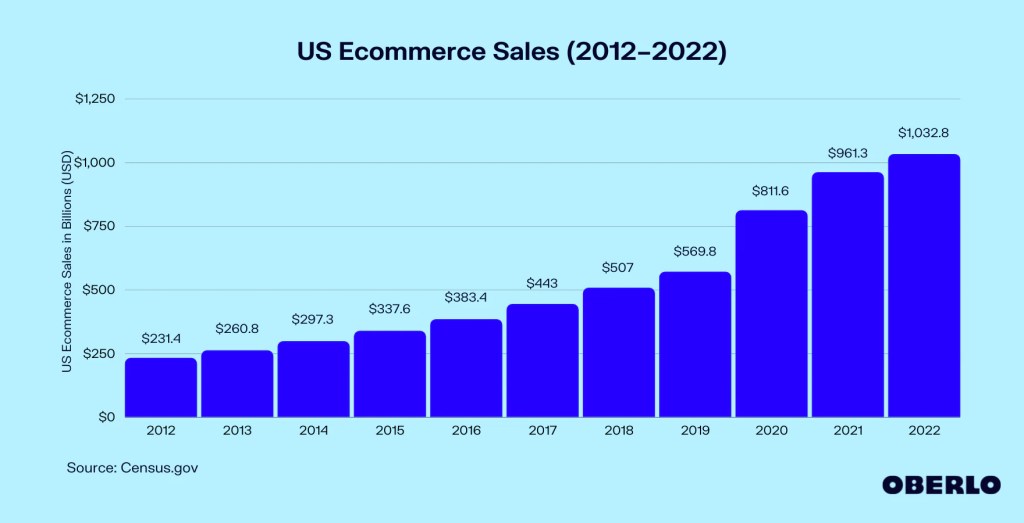
Source: Infographic courtesy of Oberlo.
How Do You Define E-Commerce and How Does It Work?
E-commerce follows the traditional marketing funnel as I have discussed in prior posts, but it also includes additional roles that other digital marketing specialties don’t necessarily include.
These complimentary areas involve social media marketing and e-mail marketing.
Some of these additional roles are, for example, product management, order fulfillment, shipping & receiving, customer service, and financing.
E-commerce in its most basic form is characterized as the exchange (buying or selling) of any good or service utilizing the internet.
Traditional offline or brick-and-mortar commerce involves a physical visit to a store location, combing through products on a store shelf, trying out the product (e.g., in a dressing room), and interacting with a store clerk.
After all of that, you finally make your way to a check stand or register to pay for the product(s) prior to leaving the store location and returning how with your purchase.
This process can be incredibly time consuming.
Many people have better things to do then to spend a Saturday or Sunday afternoon walking up and down store aisles, or moving from store to store in a giant shopping mall.
E-commerce streamlines the entire process of buying and selling – you visit the store virtually through your computer, you browse web pages, click on drop down menus to sort products by brand, style, price, etc.
The product(s) are added to your virtual shopping cart, and then purchased through a digital checkout system.
When the order is fulfilled at the e-commerce distribution center, it is shipped to your address of record, or you arrange to pick the items up at a local retail location.
The latter is commonly referred to in the retail industry as ROPIS – Reserve Online, Pick up In Store.
What Types of Products or Services Can Be Sold Online?
There are four (4) general categories of products or services that you will find being sold online, which of course encompasses millions of individual products.
These categories can be broken down in this manner:
- Physical Goods (e.g., a pair of shoes, household appliances, and even automobiles);
- Digital Goods (e.g., e-books, music files, and Coursera learning courses);
- Services (e.g., online tutoring and business consulting services);
- Software (e.g., Adobe Photoshop and popular malware programs like Avast);
Note: Software downloads of computer programs – such as the paid version of Avast Antivirus – are distinguished from digital goods in the e-commerce industry.
Avast also offers a very popular free version for download as well.
The True Benefits of Selling Online
Brick-and-mortar stores have to maintain a physical space, must remain open during certain hours, and are dependent upon whether or not customers can make it to their location.
E-commerce stores enable customer interactions 24/7, and the only requirement is a device that’s connected to the internet.
Here are additional advantages of maintaining an e-commerce store:
- Low startup and overhead costs (e.g., no required retail space overhead);
- Product sales can occur more quickly (e.g., shelves do not have to be restocked);
- Adapt to customers’ needs more rapidly (e.g., based upon analytical data from your e-commerce platform such as Shopify);
- Engage customers looking for products or services that may not be sold at a local brick-and-mortar;
- Examples of this may include the following:
- Clearance or discontinued items;
- Winter clothing sold during peak summer months;
- An older version of a textbook for a university course;
- Examples of this may include the following:
- Wider variety of products can be offered, without retail space restrictions;
Here are some caveats to be aware of when operating an e-commerce site:
- Higher rates of return (e.g., since customers can’t go to a dressing room, or touch and feel an item before purchasing)
- Shipping and handling expenses (e.g., free shipping with purchases over a certain dollar threshold is a common incentive)
- Remote customer service (e.g., posing certain logistical challenges)
All of these challenges can be managed – the important thing is you’re aware of the potential issues ahead of time.
Note: Stores which operate in both the offline and online retail space are referred to in the industry as click-and-mortar stores.
Common Terminology Used in the E-Commerce Space
These are some of the more common terms you’ll want to be familiar with in the e-commerce industry:
Visits – the number of unique visitors to a website.
Traffic – the aggregate or total number of unique visits received by a website.
Landing Page – the first page a website visitor encounters (e.g., a product page or newsletter sign-up page); the main purpose of this page is to convert website traffic into either leads, or paying customers.
The homepage or main page of a website is not always the best place for a customer to discover your products or services.
You may want them to first arrive on a landing page.
An example would be a product specific page that offers a free 30-day trial for a digital good, such as the premium version of Canva.
Note: I am going to devote an entire future blog post to the nuances of landing pages, and provide exemplars of the most effective ones implemented by various companies.
Call To Action – this tells a customer what they should do next to continue the product journey (e.g., “Add to Cart” or “Proceed to Checkout” or “Download Now”).
Digital Shopping Cart – just like it sounds, it is the virtual equivalent of a real shopping cart, and enables the customer to track what they plan to purchase.
Online Checkout Process – this is the virtual equivalent of a check stand in a supermarket.
This is where shipping and handling costs are added, as well as additional items such as up sells or cross sells (e.g., adding an extended warranty).
Payment Service Provider – often referred to as a merchant account; think PayPal or any secure way of processing a transaction online; will include the ability to accept credit cards, debit cards and ACH (e-checks), for example.
Conversion – when a customer completes a purchase or takes a desired action such as registering for a notification service for a new product release date.
E-Commerce Platform – a SaaS (software as a service) or Open Source platform that facilitates the operation of an e-commerce store.
Shopify is an excellent example of a SaaS e-commerce platform.
You can build and manage your e-commerce store, engage in marketing campaigns, coordinate shipping and fulfillment, establish payment services, and utilize built-in analytics tools.
Salesforce, a CRM or customer relationship management platform, and Google Analytics, would be two good complementary services to your Shopify account.
Some additional e-commerce platforms to consider, beyond Shopify:
- Wix – SaaS (web-based software available by subscription);
- Squarespace – SaaS (web-based software available by subscription);
- BigCommerce – SaaS (web-based software available by subscription);
- WooCommerce – Open Source (allows editing of original source code);
- Magento Open Source – Open Source (allows editing of original source code);

E-Commerce Strategy Guide – Six Essential Elements
The Gen X demographic is defined as people born between 1965 and 1980 (currently ages 42 – 57), and the Millennial demographic (also known as Gen Y) is defined as people born between 1981 and 1996 (currently ages 26 – 41).
Gen Xers and Millennials are the biggest online shoppers, with 67% of millennials and 56% of Gen Xers preferring to shop online versus in a brick-and-mortar store, according to a research article about online shopping by Kinsta.
These are of course not the only demographic that will continue to utilize e-commerce in their daily lives.
A good e-commerce strategy will help companies tap into these profitable demographics.
An e-commerce strategy is a “working” plan designed to promote an online store and grow its sales – every online store should have a written strategy for attracting customers and increasing sales.
There are several things an online store can incorporate into a cohesive strategy in order to maximize revenue.
Let’s break them down…
A Google Business Profile
Setting up this free profile will allow your business to customize how it appears on local Google Search and Google Map listings.
Note: A Google Maps listing is normally reserved for online stores that also have a local brick-and-mortar location in the select area.
Organic Social Media
Nowadays, 40% of online customers discover previously unknown brands while interacting with their personal network on social media.
Source: statistic courtesy of Sprout Social.
You should have a free organic listing or presence on most, if not all, of the major social media platforms.
Paid Search, Display and Social Media Ads
Studies have found that the best results are the byproduct of a combination of organic and paid content.
Paid ads allow advertisers to control their branding, the actual message or ad copy, which pages the site visitor would be directed towards (e.g., website landing pages), bidding strategies, and the ability to assess performance through analytics.
Paid Shopping Ads
Facebook, Instagram and Google Shopping, all offer great opportunities for paid shopping listings.
Influencer Marketing
Some companies, such as Fashion Nova, have grown their brand to global proportions by relying almost exclusively upon Influencer Marketing on social media platforms.
It is now estimated that around 35% of online customers find new brands through influencers they follow.
A paid influencer campaign should be a consideration as part of an overall e-commerce strategy.
In-Store Ads
Lastly, if you are running a click-and-mortar business or hybrid e-commerce operation (serving both in-store and online customers), then in-store ads informing customers about the convenience, and cost-effectiveness of ordering online, can be highly effective.
Staples Inc., for example, has in-store kiosks that allow an employee and/or customer to place an online order right on the retail floor, and arrange to have the items delivered directly to their home or business, or delivered to the store for pickup at a later date.
Note: One effective strategy is to reserve the availability of certain items (such as hard-to-find sizes and clearance items), for online customers only.
A Preview of the Upcoming Part 2
In Part 2 of this blog topic on e-commerce marketing, I will address additional important considerations such as…
- Branding in e-commerce;
- E-commerce market research;
- Primary and secondary sources;
- Competitive analysis (free template);
- Product research and product sourcing;
- Anatomy of today’s e-commerce stores;
- Identifying a target audience or ideal customer;
- From the home page to order confirmation page;
- Customer engagement, loyalty and brand advocacy;
Conclusion
Have you ever thought about starting your own online store?
What types of products or services would you consider offering for sale?
Did you realize any barriers to starting in e-commerce are 100% manageable?
Feel free to leave a comment below.
If you have not already done so, please don’t forget to Subscribe in order to receive periodic updates on valuable digital marketing strategies delivered right to your e-mail inbox!
See you in the next blog post…

 Insightful Digital Marketing