

Table of Contents
- Key Takeaways
- Introduction: Consumer Positioning
- What is Positioning in Marketing?
- We are Assaulted Everyday by Messages
- Get There First, or Otherwise Position Yourself
- Which Rung of the Consumer Ladder Does Your Brand Occupy?
- Positioning a Leading vs. a Following Brand
- How to Reposition Your Competition
- More Corporate Success Stories
- The Future of “Positioning” in Marketing
- Conclusion
Key Takeaways
- One of the most influential books ever written on communication;
- Published in 1981, it contains concepts that still apply today;
- Learn to incorporate this book’s lessons into your brand;
- Examples from major consumer brands on positioning;
Introduction: Consumer Positioning
This is a bestseller review of the classic marketing publication Positioning: The Battle for Your Mind – by authors Jack Trout and Al Ries.
In 1972, advertising and marketing professionals Jack Trout and Al Ries (pronounced “Reese”) wrote a three-part series of articles for Advertising Age centered on the concept of “positioning” a product or service in the already crowded and noisy consumer marketplace.
The ideas discussed in that series were the inspiration for their best-selling marketing classic.
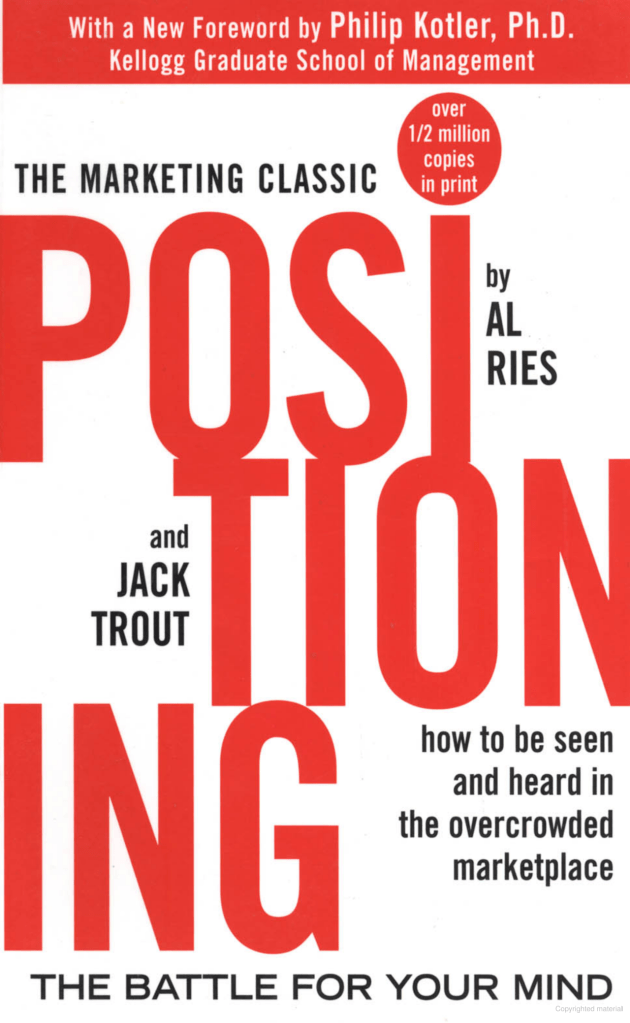
Source: Book cover image courtesy of The McGraw-Hill Companies.
What is Positioning in Marketing?
“Communication” alone is not enough to get the attention of the consumer or society in general. Instead, you must establish a “position” in the mind of individuals – a position which addresses the pros and cons of your company, as well as the pros and cons of your competition.
In order to break through the overcrowded marketplace, you must carve out a section of real estate if you will in people’s minds, where your brand resides.
Why would you want to highlight both strengths and weaknesses of your brand, and your competitor’s brand? The answer depends on how you want to position your product or service in the consumer’s mind.
We will go over several real-world corporate success stories involving well known consumer brands, and explain why the strategy of positioning – highlighting strengths and weaknesses of a brand – has been so effective over the years.
We are Assaulted Everyday by Messages
The average consumer is assaulted or bombarded every single day by advertising and marketing communications. According to a study on advertising expenditures published by Statista, the per-capita spending on advertising in the United States stood at $920.84 as of 2021.
When Positioning was first published back in 1981, the per-capita spending on advertising was $376.
It was estimated back then, that an advertising spend of $1 million per year would only expose the average consumer to less than one half cent ($0.005) of advertising – spread out over the entire one-year period.
The solution as outlined in Positioning is to not continue to pile more advertising on top of advertising in an attempt to change or alter people’s minds – although a reasonable amount of advertising is important.
Instead, companies and brands need to segment their audience and aim their messaging in a much more select and tailored manner. In other words, they need to “position” themselves in the consumer marketplace.
Get There First, or Otherwise Position Yourself
Ideally, in a perfect world, you should be the first to establish your brand as a leader in a particular product or service sector. In doing so, you would automatically be positioned in the minds of the consumer.
However, in most cases you will not be that fortunate – already established brands will likely be competing for their slice of market share.
Therefore, you will need to position or distinguish your brand against the competition, in such a way that makes your product or service stand out in the mind of consumers.
How do you accomplish that task?
As mentioned previously, we are going to go over several examples of how major brands have successfully accomplished that very objective and ultimately generated billions of dollars in additional revenue as a result.
Stay tuned…
Which Rung of the Consumer Ladder Does Your Brand Occupy?
Consumers compartmentalize or rank products and services based upon where they perceive them to be in the hierarchy of the product or service food chain.
The Story of Haagen-Dazs Ice Cream
What is your favorite brand of ice cream? I personally like either Ben & Jerry’s (Chunky Monkey) or Haagen-Dazs (Vanilla Milk Chocolate Almond bars).
When Haagen-Dazs first introduced their line of ice cream, they purposefully positioned themselves as a “premium” brand, by marketing their ice cream as a more expensive alternative to other brands and selling their product in only select retail locations.
Nowadays, you can walk into most supermarkets and purchase a variety of Haagen-Dazs branded ice cream, but, you will still pay a premium price for their product compared with other ice cream brands in the freezer section.
This promotional strategy by the company resulted in one of the most enduring marketing successes in our modern times.
On the other end of that marketing spectrum, you will find brands such as Kia and Mitsubishi in the automobile industry, and Southwest Airlines in the commercial travel industry.
These brands have intentionally positioned themselves at the lower or more affordable end of the consumer market.
Positioning a Leading vs. a Following Brand
To be a leading brand, it generally means you have to be the first (or at least one of the first) companies to occupy that product or service space in the consumer’s mind.
If you find yourself in that front-runner position, it may be even more of a challenge to remain at the top – so you still need to follow the positioning strategies that got you there in the first place.
Brands which find themselves following or trailing a leader, must differentiate themselves by finding a crack or niche in the consumer market not occupied or monopolized by anyone else.
Story of Avis Rental Car
In the early 1960’s, back in the day, Hertz was the leading rental car company brand in the United States (the Enterprise Rental Car Company now holds that title).
Hertz’s main competition at the time was Avis and Budget.
In order to position themselves against Hertz as the leader, the Avis Rental Car Company developed the slogan of “We Try Harder” than the leading competition.
Avis did not try to outrank Hertz, but instead, they embraced their No. 2 position and created the perception in the mind of consumers that they would virtually bend over backwards to be sure their customers were more satisfied with their rental cars and related services.
During the first five years of the “We Try Harder” campaign, the market-share gap between Hertz and Avis was reduced from 61%-29% to only 49%-36%, still in favor of Hertz.
Avis was able to close the gap between themselves and Hertz by an amazing 19 percentage points during those initial years, by implementing a brilliant positioning strategy.
The campaign ran in various forms for the next 50 years around the globe, became a virtual mission statement for Avis, and is considered one of the most successful strategic positioning campaigns in the history of advertising.
Story of Pepsi-Cola
In 1984, Pepsi-Cola employed a similar strategy when they came up with their slogan of being “The Choice of a New Generation” as a way to differentiate themselves against longtime market leader Coca-Cola.
In other words, the campaign implied that the “Pepsi Generation” was youthful and optimistic, while anyone who chose to consume Coca-Cola was not youthful and optimistic.
How to Reposition Your Competition
“Repositioning”, also known as “Depositioning”, is the art of changing the beliefs and mindset of the consumer about a competing brand.
One of the most memorable repositioning strategies occurred in 1966, when Scope (Procter & Gamble) used the slogan “Fights Medicine Breath” to distinguish their brand from the current market leader at the time in the mouthwash category, Listerine.
This repositioning campaign established Scope as a better tasting (and smelling) alternative – while still preventing bad breath – Listerine’s original claim.
This would certainly not be the last time a brand used this type of approach to their advantage.
The Story of Tylenol Pain Reliever
Tylenol vs. Aspirin – In 1982, Tylenol was considered to be one of the greatest success stories in the history of marketing.
Parent company Johnson & Johnson took their pain relieving product with virtually no brand awareness prior to 1975, and created the largest-selling brand in the world amongst the lineup of health and beauty products.
Heretofore, aspirin was manufactured in powder form, and promoted under generic labels – except Bayer aspirin – by drugstores and supermarkets.
Tylenol is a non-aspirin pain reliever that was predominately marketed to physicians – similar to the way a prescription drug would be promoted.
Johnson & Johnson then changed their main distribution strategy to over-the-counter (OTC) and first positioned Tylenol in consumer’s minds as a pain reliever that does not carry any of the side-effects that can be attributed to aspirin.
The first advertising spots emphasized the brand’s mildness. Tylenol was later reformulated (increasing the dosage of each tablet to 500 mg) and positioned against aspirin’s typical low dosage of only 325 mg.
By directly stating the deficient dosage and potential side-effects of aspirin, Tylenol re-positioned aspirin products in the public’s mind, and positioned their pain relieving product as a superior alternative.
The OTC packaging all emphasized “Extra Strength” and sales of the brand subsequently soared.
More Corporate Success Stories
Here are some additional examples of products and services that have successfully leveraged the concept of positioning:
- In-n-Out – positioning strategy: “Quality You Can Taste”; easy in and easy out, offers an affordable, good quality burger combination that is a cut-above other fast food options
- Netflix – positioning strategy: “See What’s Next”; connecting people to storytelling is at the heart of Netflix – they capitalize on their audience’s anticipation of the next moment, the next episode, the next season
- Papa John’s – positioning strategy: “better ingredients, better pizza” – implying that all the other pizza chains have inferior pizza due to inferior ingredients
- Trump Plaza – positioning strategy: “Atlantic City’s centerpiece” based upon its central boardwalk location
- Uniroyal – positioning strategy: the automobile tire company that “holds the most patents” – implying superior safety and quality due to their industry-leading portfolio of patents
- Wynn Hotel & Casino – positioning strategy: operating the only hospitality resort in the entire world with a “five star, five diamond” rating
- Miller Lite – positioning strategy: “Great Taste, Less Filling” – addressing the public misconception that low calorie beers were tasteless, and positioning themselves as the one brand that offers both benefits to the consumer
Note: The concept of positioning can be applied to yourself and your career as well – establishing your own unique personal brand or identity.
The Future of “Positioning” in Marketing
In 2009, Jack Trout authored a follow-up book to the original classic Positioning, which he aptly titled Repositioning: The New Battle for Your Mind.
In that book, he noted that modern brands will need to focus more and more on re-positioning the consumer’s already occupied mind.
In other words, how can your brand adjust the way a consumer thinks about the competing brand they already use on a regular basis, in such a manner, as to encourage someone to switch their allegiance from Brand A (your competitor) to Brand B (your brand).
He went on to discuss the fact that advances in technology and competitiveness were the catalysts driving change at exponentially faster rates, and this new transformed economy will force companies to revamp their positioning of products and services in order to keep pace.
Repositioning essentially explains how marketers can amend their original positioning strategies, and effectively confront competitors where they are most vulnerable.
Whether you are a marketer using traditional marketing vs. digital marketing, or a combination thereof, positioning is a marketing concept that has stood the test of time and is not going anywhere, anytime soon.
Conclusion
Jack Trout and Al Ries worked together in advertising and marketing for over twenty-six (26) years.
Between the two of them, they represented major clientele such as Paramount Pictures, AT&T, Carvel, KPMG, Sothebys, IBM, Humana, Southwest Airlines, Procter & Gamble, and the United States Department of State, to name a few.
Mr. Trout passed away on June 4, 2017, at his home in Old Greenwich, Connecticut – he was 82 years of age. In addition to Positioning, he was an acclaimed author of many more classic marketing publications such as The 22 Immutable Laws of Marketing and Differentiate or Die: Survival in Our Era of Killer Competition.
Mr. Ries passed away on October 7, 2022, at the age of 95, in Atlanta, Georgia. His contributions as an author and leader in the advertising and marketing industry were recognized by the American Marketing Association, and he was inducted into the Marketing Hall of Fame in 2016.
Feel free to leave a comment below.
If you have not already done so, please don’t forget to Subscribe in order to receive periodic updates on valuable digital marketing strategies delivered right to your e-mail inbox!
See you in the next blog post…

 Insightful Digital Marketing