

Table of Contents
- Key Takeaways
- Introduction: Social Media (Part 2)
- On-Brand vs. Off-Brand Posts
- Effective Types of Social Media Content
- How To Acquire Earned Social Media
- Real-Time Marketing (RTM)
- Effective Use of Social Media Calendars
- Social Media Management Tools
- Social Listening
- Social Engagement
- Social Marketing on Mobile Devices
- Social Media Writing
- Designing Effective Content
- “Repurposing” Social Content
- Accessibility for the Disabled
- Conclusion
Key Takeaways
- Important branding methods;
- Popular types of social media content;
- How a strong social media presence can be earned (free);
- Capitalizing on the modern real-time marketing environment;
- Making effective use of social media calendars & monitoring tools;
- How to integrate the right mixture of content and engagement;
- The art of social listening and the science of social engagement;
- Social marketing on mobile devices and why it’s so important;
- Social media writing styles and designing effective content;
- Various ways to “repurpose” your social media posts;
- Making your content accessible to the disabled;
Introduction: Social Media (Part 2)
“If you make customers unhappy in the physical world, they might each tell 6 friends. If you make customers unhappy on the Internet, they can each tell 6,000 friends.” – Jeff Bezos, Amazon founder, on Social Media Marketing
On-Brand vs. Off-Brand Posts
When a digital marketer posts content on social media, it is imperative that the communication be on-brand – that is, it must be consistent and true to what the company represents as its core values, messaging tone and overall outlook. Posting content that is the antithesis of this would be considered off-brand.
Understanding the difference between on-brand and off-brand content – however subtle – is critical to your being able to critique messaging posted by a colleague, for example, that misses the mark and would be deemed off-brand.
It is best to follow a template or guideline to help you provide constructive feedback to someone else as to why their content is not on-brand.
Branding Template
Here is a template that may be used to ensure your message is on-brand:
- Does the company sell products or offer services?
- What types of products or services does the company offer? Distinguish between B2B and B2C? Exemplars…
- “Outdoor clothing” such as sold by the Patagonia brand
- “Sports drinks” such as sold by the Gatorade brand
- “Accounting services” such as provided by the Pricewaterhouse Coopers brand
- What type of language does the company normally use to communicate to its target audience? Exemplars…
- “High quality, long lasting” (Patagonia)
- “For all types of athletes” (Gatorade)
- “A full-service corporate accounting firm” (Pricewaterhouse)
- What language does the company use to differentiate itself from their competitors? Exemplars…
- “Eco-friendly guarantee” (Patagonia)
- “#1 post-workout drink” (Gatorade)
- “Providing business solutions for over 100 years” (Pricewaterhouse)
On-Brand Checklist
- Post should align with your brand – cite examples and provide explanations
- Post must be consistent with your brand’s messaging – cite examples and provide explanations
- Post supports the company’s mission – show examples of how this is accomplished
- Post uses the same or similar verbiage as your brand’s positioning statement – cite to examples of the actual language being used
- Post relies upon the same or similar examples that can be found in your brand’s positioning statement – cite to specific examples
- Post conveys a tone, style, and voice that are consistent with your brand – cite to examples which show the correlation
Off-Brand Checklist
- Post does not align with your brand – cite examples
- Post is not consistent with your brand’s messaging – cite examples
- Post does not support the company’s mission – cite examples
- Post does not use the same or similar verbiage as your brand’s positioning statement – cite examples
- Post does not rely upon the same or similar examples that can be found in your brand’s positioning statement – cite examples
- Post does not convey a tone, style, and voice that are consistent with your brand – cite examples
Effective Types of Social Media Content
Generating engagement is the key as to whether or not your social media marketing is going to succeed – you need to produce effective content that resonates with your target audience.
Employing a variety of content approaches will help to ensure you accomplish this goal. This means you should have a social media content plan that reflects a variety of content types.
In 2022, Sprout Social collected data from 729,000 public social profiles to determine what types of social media content was the most engaging to an audience.
Their 2023 Content Benchmarks Report identified the following:
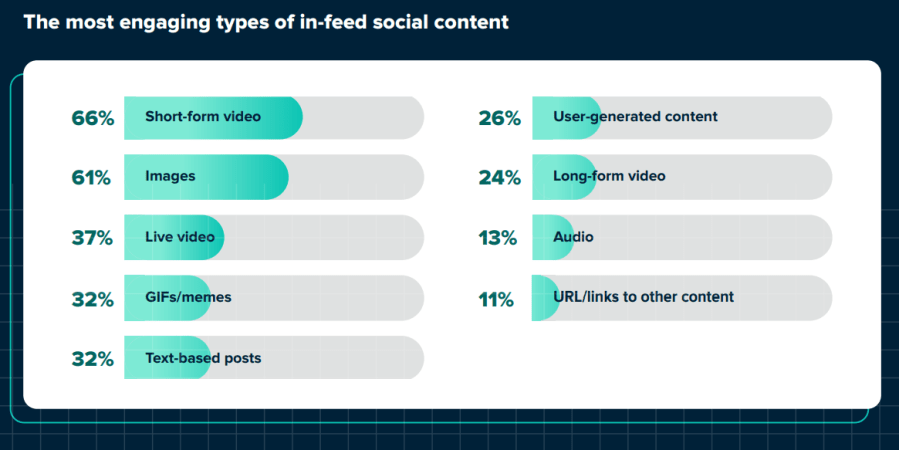
Source: Infographic courtesy of Sprout Social.
Content Buckets
The best way to accomplish having a plan that diversifies its content is to divide your messaging or posts into separate content buckets – categories in which you group your marketing content. The buckets are normally labeled into relatively broad categories that are used to achieve a particular goal or to make your customers feel a certain way.
These categories or themes are designed to reflect different aspects of your business and target audience.
Some of the more common social media content buckets are as follows:
Entertaining – this type of content is geared towards people seeking fun and enjoyment on a platform. Entertaining social media content can make a company more relatable to its audience.
Examples: Viral Videos; Jokes; Comics; Contests; and Memes.
Educational – this approach can be used to build authority and trust in a brand – as well as setting a company or individual apart as an industry leader.
Examples: Training Courses; Infographics; White Papers; Blog Articles; Case Studies; and FAQs.
Inspirational – this content frequently utilizes actual customers or real people, and shows them using a product or service. This is a great way to establish authenticity and to reaffirm your brand’s values with the public.
Examples: Testimonials; UGC (User Generated Content); Facts and Trivia; and Company Beginnings.
Conversational – the objective is to create audience engagement – start a conversation by proposing a topic (e.g., developing news story) for discussion and inviting feedback.
Examples: Polls – True/False; Fill in the Blank; and Opinion polls.
Promotional – this type of content highlights a product or service, and then offers some type of incentive for the consumer to take action.
Examples: Coupons; Discounts; Free Shipping; BOGO; Giveaways; and Sweepstakes.
Content Formats
Social media posts can appear in a variety of formats from Single Images (e.g., Infographics), Videos (short and long form), Carousels, Written Posts, Stories, GIFs, Links, Polls, and Live Feeds.
Here is a summary of the more commonly utilized formats on today’s social media platforms:
Videos – excellent for capturing people’s attention and easier to digest than a bunch of text on a page. Thanks to smartphones, creating videos is a fairly straightforward process. Content types which work well for video include…
- How-to guides (e.g., home maintenance and repair)
- Video tours (e.g., virtual open houses)
- Product demonstrations (e.g., how to operate an E-Bike)
Images – more posts include images than any other format across social media. An effective image can be understood almost instantly, which in turn gives consumers an immediate impression of your brand.
Content types which work well for images include…
- Infographics (graphic representation of information or data);
- Animated GIFs (a moving picture in the GIF format);
- Caption photos;
- Screenshots;
Written posts – can be a great way to engage your audience and serve as a catalyst for starting conversations that may lead to long-term customer relationships. Allows brands to share in-depth information about their products and services.
Content types which work well for written posts include…
- Blogs;
- Guides;
- Articles;
- Case Studies;
- Whitepapers;
- E-Publications;
Stories – this type of content format is designed to last for a limited amount of time – 1 to 7 days before disappearing.
Excellent for providing updates on events, product or service offerings, new hires, major company changes (e.g., company merger or company rebranding). Audio and visual elements can be incorporated.
Live videos – you will see this type of format typically used for webinars, Q&A sessions, and conferences and performances.
This format is also the best at creating a sense of community with your audience due to the inherent interactions which take place.
Content Formula
Ideal Content Bucket + Most Compatible Content Format = Best Content Messaging for Social Media
How To Acquire Earned Social Media
Earned media is essentially any type of positive or supportive digital exposure as a result of a personal or public recommendation. This is akin to what has long been referred to as “word of mouth” advertising.
This type of media can be generated by your friends, family, unpaid influencers, and product reviews.
Nowadays, potential consumers pay very close attention to earned media – both good and bad.
If a customer or client likes your product or service enough to take the time to post about it online – without getting compensated – you are getting free positive publicity which reinforces the fact that your audience believes and trusts your brand.
Due to the lack of control a brand has over earned media, it is considered by many to be one of the most challenging marketing tactics at which to be successful.
Earned Media Examples
- Customer reviews on your Google Business Profile;
- Blog posts on various platforms about your brand;
- Chat room discussions about your brand;
- Mentions of your brand on social media pages;
- Community forums about your brand on sites such as Reddit;
Set Yourself Up for Effective Earned Media
While earned media is not something you can exercise a lot of control over, there are some concrete things you can do to put your brand in the best possible light to receive potential shares, reposts, mentions, and positive reviews. Here are some of the best ways to accomplish that objective:
- Create engaging content which will encourage your audience to share with others;
- Nurture relationships you may have established with other brands, members of the media, journalists, etc. – positive press can go a long way towards reinforcing the trust people have in your brand;
- Go above and beyond when providing customer service – when your audience approves of the way in which they are being treated (whatever that relationship may be) they are more likely to share their brand experiences with others;
- Look within your own organization and encourage staff members to share their stories about what makes your company such a special place;
Earned media is particularly critical to a brand that may have a limited budget to spend on advertising and marketing.
Real-Time Marketing (RTM)
Today’s news cycle is more fast and swift than it has ever been. A breaking news story might be tweeted – and then the next thing you know the discussion might suddenly end.
Real-time marketing demands that companies produce fresh and interesting content that keeps pace with the changing news cycle on social media.
The Importance of RTM
RTM is marketing that happens around the clock, in real time. Social media is one of the main platforms where RTM lives because of how rapid discussions and engagement takes place there.
If there are millions of social users interacting with each other, your brand may want to be part and parcel in an attempt to boost engagement.
If it is done right, brands can leverage those moments and attract new followers by positioning their brand wherever they want in certain discussions.
How to Conduct Effective RTM
- Your content should be relevant – What is happening on social media right now and what topics are the discussions centered around?
- Your content should be clever – What ways can you display your brand’s personality in the content you post?
- Your content should be fresh – Is your content timely enough to take advantage of a trending topic on social media?
- Your content should be on-target – Does your social media audience find a particular topic or event to be of interest?
- Your content should be attention-grabbing – You want people to stop scrolling through their social media feeds and pay immediate attention to your post.
Key RTM Strategies
Always be listening – spend as much time as possible on social media platforms so you can track any trending topics.
Use your brand’s resources – enlist the help of a design or copy editing team member to help create quick, high quality posts.
Leverage social media influencers – depending upon your relationship, social media influencers can be a great way to amplify your RTM.
Know where the conversation is happening – what social media platforms are hosting the most discussions about a particular topic?
Promote some of your posts – your organic posts may not reach a wide enough audience due to a platform’s algorithms. A promoted post can help bridge this gap because you are paying a social media platform to make your content more visible.

Effective Use of Social Media Calendars
This type of calendar will help you track, manage, organize and publish all your social media posts. Google Sheets, Hootsuite, and Asana are all good resources for creating and maintaining a professional looking and functioning social media calendar.
Main Benefits of Using a Social Media Calendar
- Schedule your posts in advance;
- Organize your content in one centralized location;
- Share your social media calendar with stakeholders;
- Plan around cultural events, national events, and important holidays;
- Help you avoid major mistakes in your content and scheduling;
Calendaring Elements to Include for Each Post
- The post’s title;
- The body of the post;
- Where it is being published;
- The date and time it will be live;
- Links to assets such as photos or videos – maintain a content library for images, videos and audio files on a storage system such as Google Drive;
- List related documents or information;
- Indicate what KPIs (performance metrics) you are tracking;
- Days of the week and times of the day you’ll post on each platform;
- Which stakeholders will review and approve content;
- How future content will be created;
Social Media Management Tools
Social media management tools can be helpful for creating content, locating content, scheduling posts, and measuring analytics. Some of the best free and paid tools on the market include the following:
Content Creation
Content Curation
Content Scheduling
Content Analytics
- Hootsuite Analytics (fully integrates with social media platforms);
- Brandwatch (track a brand’s reputation, competition, influencers, etc.);
- Mentionlytics (monitor mentions and keywords across social media);
Social Listening
Social Listening is essentially the art of monitoring and assessing conversations and trends, as they relate to your product or service brand.
You can quickly discover what exactly people think about your brand, which can help guide your marketing and product development decisions.
Monitoring Social Data
Monitoring platforms for whenever social media users mention your brand, products, services, competitors, as well as keywords related to your industry.
Analyzing Social Data
Analyze the data you have gathered as a part of the first step, and implement actions based upon that information.
For example, you may have a disgruntled customer that is seeking feedback from your company, or you may see a product or service trend that you might capitalize on by adjusting your entire social media marketing strategy.
Social listening can shed light on the overall sentiment surrounding your brand – in other words the attitude and feelings people have about your company.
If you know how the consumer feels about your brand, you can shift your strategy or emphasize an aspect of your existing strategy, in response to those expectations.
Engage With Customers
Once you’ve honed in on consumer sentiments, you will be in a prime position to have a meaningful discussion with your customers and followers about your brand.
A customer may comment about how much they enjoy a particular model, or they may inquire about how a particular feature is supposed to function.
This sets up a great opportunity for you to engage with those customers on a one on one basis.
Your customers want to be heard and taken seriously on social media, and providing them with feedback can lead to increased brand loyalty and customer retention rates.
Responding to Adverse Feedback
In addition to positive social media feedback, you will undoubtedly face some negative social media responses from your customers – and they will share that feedback with other social media users within their networks.
When you do encounter negative social media sentiments being expressed about your brand, social listening is your key ally to help pinpoint the negative noise and formulate an appropriate response to same.
Assess Your Competition
What is another great use of social listening? Analyzing and monitoring your competition!
Follow your competition on social media and learn what strategies they are implementing and how their customers feel about their products or services.
You can find out what does and does not resonate with your competitors’ customers and create product and service offerings accordingly.
Convert Social Followers
Lastly, social listening can be used to increase customer acquisition – all those people who “follow” your brand have an interest in your content.
Once you discover the kinds of content your followers enjoy the most, you can seek to create more of this type of content that appeals to them and prospectively convert them to paying customers.
Social Media Listening Tools
There are many social listening tools to choose from on the market. Here are some of the more popular social media listening resources available:
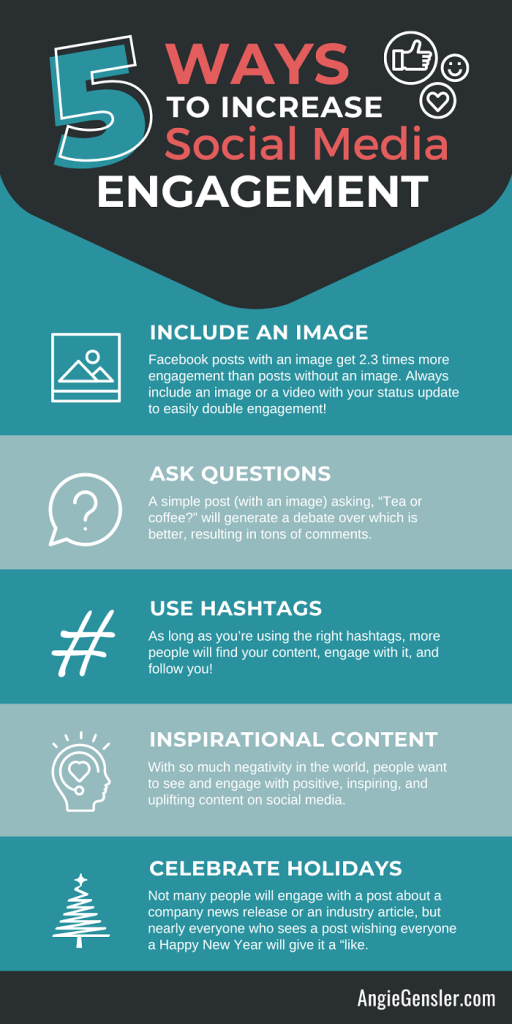
Source: Infographic courtesy of Angie Gensler.
Social Engagement
Social Media Engagement helps a company to measure how people interact with their brand and what is actually driving people to remain or become customers.
This interaction can take the form of likes, favorites, comments, reposts, shares, retweets, saves, clicks, hashtags, and mentions.
Studies have found that when a consumer feels a connection with a company, more than 50% of them will increase their spending on that company’s brand(s), and more than 75% of them will prioritize buying from those companies as opposed to buying from competitors.
A best practice is to respond to all comments and mentions about your brand, even if the feedback is negative and you do not feel like engaging the individual.
Doing so will open up a two-way dialogue and establish a healthy and professional relationship with your customers.
The best way to provide excellent customer service on your social media platforms is to be prepared to answer customers’ questions, provide resources, and show empathy for the issues they are facing which relate to your brand.
The more efficiently and rapidly a company responds to a customers’ concerns, the more trust a customer will develop in your brand.
The more authentic your responses the better – people will engage much more if they believe there is a real person reviewing and responding to comments.
There are ways to personalize your voice on social media – use a unique signature when signing off of your posts, use the first name of the people you are interacting with, and inject humor or warmth in your communications.
Images and videos of actual people employed by your company can also help create a more personable and relatable experience.
Provoking Social Engagement
What are some good ways to entice or provoke engagement from social media users? The following list can be used as a starting point:
- Hold contests;
- Post daily polls;
- Develop quizzes;
- Ask group questions;
- Feature customers and employees;
- Encourage UGC or user-generated content;
- Offer coupons, discounts, guides, reports, and studies;

Social Marketing on Mobile Devices
Mobile marketing involves reaching an audience while they are on their smartphones, tablets, wearable devices, etc.
Social media and mobile marketing are inseparable – in July 2021, a Facebook study showed that over 98% of users worldwide accessed the platform from their smartphones.
What are the main benefits of mobile marketing on social media? Here are the key ones:
- High engagement rates;
- Super wide audience reach;
- Increased customer conversions;
- Effective targeting of social users;
- Personal connections with customers;
- Rapid customer response time to offers;
- Access to UGC or user-generated content;
- Results are easy to track through analytics;
Social Media Tips for Mobile Marketers
Create mobile-friendly posts – test your layouts and images; make sure links lead to mobile-optimized landing pages; focus on creating shorter posts.
Integrate video – video content is the number one type of content that people engage with on their mobile devices – including videos in your social posts will help draw maximum attention to your content.
Your videos should be no longer than 15 to 30 seconds in length because most social media users have very short attention spans, especially when it comes to the use of their smartphones.
Focus on the most important and relevant features of your products or services at the outset of your video in order to hook or maintain the attention of your audience. Alternatively, producing content that is “live” is another great option for mobile marketing.
Facebook, YouTube, and Instagram Live, are all great examples of platforms that allow for content to be shared in a live stream environment.
Ask customers to check in – asking customers to “check in” at your business on social media is a great way to gain earned media.
This can be particularly helpful for local businesses wishing to develop a loyal customer following within their communities – also known as good old-fashion repeat business.
This process of “checking-in” sends an important signal to the customers’ friends and followers on social media that they are patronizing your business.
You can also incentivize this activity by offering customers perks like discounts, coupons, and rewards points for regularly checking-in at your local business.
Encourage user-generated content – user-generated content, or UGC, is content created by customers or clients of your brand, as opposed to the brand itself producing the content.
Fashion brands such as Shein, Fashion Nova, and Gymshark, which I have discussed in prior blog posts, have done a great job of growing their customer base by encouraging and incentivizing UGC.
Whenever someone sees content posted by an actual customer or user of your products or services, it comes across as authentic and builds even more trust in your brand.
This will in turn boost your social media engagement rates. Thanks to mobile device technology, creating UGC is easier than it has ever been.
Similar to “checking-in,” you can encourage users to submit UGC by running contests which invite them to post photos or videos of themselves on social media, while using your product or service.
Leverage influencer marketing – the last social media tip I’ll share in this post for mobile marketers has to do with the art of online influencing.
More and more brands are collaborating with influencers at all levels to help market their products or services.
In a detailed article addressing micro-influencer marketing, SproutSocial broke down influencer marketing into four (4) main categories:
- Nano-influencers (1k – 10k followers)
- Micro-influencers (10k – 100k followers)
- Macro-influencers (100k – 1M followers)
- Mega-influencers or Celebrity-influencers (1M+ followers)
Mobile marketing allows these influencers to promote your brand conveniently and remotely to their followers – in whatever location the brand and influencer feels would be the best.
The key to working with influencers is as follows:
–> Identify the ones that share the same or similar target audience as your brand;
–> Use the same social media platforms as your target audience;
–> Have built a strong rapport with their own followers;
Social Media Writing
When you write and disseminate social media content, make sure you are addressing your audience’s interests, values, needs, and any obstacles and challenges they may be facing.
Your level of engagement on social media will increase exponentially if you put the needs of your audience at the center of your writing.
Once you identify their perspective(s), explain how your product or service can either enhance or improve their lives, and explain how your product or service supports any of their own personal interests and values (e.g., eco-friendly concerns, social justice reform, community outreach, and religious or political ideologies).
Here are the key points to keep in mind when it comes to your writing style on social media:
Speak the same language as your audience – in addition to considering your audience’s perspective, you’ll want to learn to speak like your audience.
Content posted on LinkedIn which is aimed at professionals should have a much different tone than content you would post on TikTok which might be aimed at a Generation Z audience.
Note: Having said all that, a strategy which can be effective for getting people’s attention on a social media platform, is to intentionally post content which is a departure from what users are used to seeing on a regular basis.
Keep your posts short and simple – attention spans these days are short; oftentimes no more than a few seconds.
Make good use of headlines, bullets, and lists, shorter sentences and paragraphs, and embolden important information that you wish to draw the reader’s attention towards.
Include a call-to-action – a call-to-action or CTA instructs the customer or client what they should be doing next to continue their journey through the marketing funnel.
Ten Common Types of Calls To Action
On social media, here are ten (10) of the more common types of calls-to-action:
- Sharing a post or reposting;
- Answering a poll or question;
- Linking to external content like blogs;
- Subscribing to or joining a newsletter;
- Commenting and liking a creator’s post;
- Saving and/or downloading a post for later;
- Connecting on another social media platform;
- Signing up for a webinar or other community event;
- Following an individual, and connecting with them via DM;
- Joining a group on LinkedIn or community (e.g., SEO subreddit r/SEO);
Write in your brand’s voice – even though you are going to write with your audience in mind, your brand’s distinct personality should be reflected in its communications.
The tone which best represents your company (e.g., fun and casual vs. professional and serious) must be consistently displayed across all your marketing channels.
That consistency will help establish familiarity and trust and make your brand more recognizable.
Pay attention to grammar and spelling – it should go without saying that posting content with a lot of grammar and spelling errors will tend to create a negative impression of your brand amongst your audience.

Designing Effective Content
Here are eleven (11) guidelines for designing effective content for social media:
Use simple graphics – the more simple the graphic, the more clear the message.
Use colors that drive more engagement – you would certainly want to follow your organization’s or agency’s parameters on the proper color palette, but a contrasting color can sometimes be thrown in as an attention grabber.
To help decide which colors are the most compatible, you might use Canvas’ color wheel.
Use contrast on key elements – contrast can be displayed not only by color, but also by the effective use of variations in size, texture, shape, layout, and font.
Use text that is easy to read – make your text as easy as possible to read so your audience receives the full impact of any visual content.
Use a variety of styles – most people around the world can easily recognize a brand like Coca-Cola; but if Coke kept using the same logo over and over again, their audience would be a lot less engaged.
One of their more successful global campaigns – “Share a Coke” – involved replacing the typical Coca-Cola name on bottles and cans, and substituting in commonly used first names such as “Charlie” or “Jennifer” or “Sam” or “Laurie” in the same color scheme.
UGC or User Generated Content – In addition, Coca-Cola encouraged consumers to share photos or videos of themselves on social media enjoying the beverage with their name on the outside of a personalized can or bottle.
Use smart branding – be selective about where you place your brand name and logo without having to mention same repeatedly.
Use principles of visual hierarchy – this involves placing elements of a post in a natural or predictable pattern – such as reading from left to right, and top to bottom, in a zigzag type of pattern.
This will also help to facilitate having your audience click on the most important aspects of your post such as a call-to-action button.
Use a call to action (CTA) – as discussed above, an effective CTA tells the customer what they should be doing next.
Use visuals across multiple platforms – making good use of photo and video assets by re-using them across a variety of social media platforms is a smart way to leverage your time and resources.
A video uploaded as a YouTube Short may also be a good candidate for uploading onto TikTok.
Use and create templates – create and continue to use various templates for social media content that have already proven to be successful.
There are a multitude of software programs available for photo, video, and graphic editing purposes. Many of these are paid versions, but there are also a number of free or open-source versions.
Free or Open-Source Design Software
Here are some free or open-source software programs you might try:
Photo Editing:
Video Editing:
Graphic Design Editing:
“Repurposing” Social Content
I wanted to briefly discuss what it means to effectively repurpose content on social media.
Posting content on social-media can be time-consuming; especially if you are trying to constantly develop fresh material. Therefore, it can be very helpful to repurpose your content on social media.
Repurposing content is a process of recreating and republishing content, but in different formats – this should normally be reserved for your best content.
Here are some examples of repurposing content by converting a LinkedIn webinar, for example, into the following:
- A YouTube video;
- A Spotify podcast;
- An Amazon e-book;
- A blog post on WordPress;
- A series of tweets on Twitter;
- A collection of colorful infographics;
- A how-to-guide on a website landing page;
Accessibility for the Disabled
Lastly, I’d like to discuss ensuring the content you post not only on social media, but across all your digital marketing platforms, is accessible to individuals with disabilities.
Over one (1) billion people have documented disabilities on our planet.
This includes, but is not limited to, the following: Vision, Movement, Learning, Hearing, and Mental Health.
Here are some tips for creating content that is more accessible to everyone:
Video captioning – this will help assist individuals with hearing disabilities, who speak a different native language, or who are in a place that requires a reduced noise level, such as a library.
Alternative text (alt text) – providing written descriptions of an image will assist individuals who are visually-impaired and rely upon screen readers to understand content.
Color contrast – contrast ratios measure how bright one color is against another color. In other words, how does a lighter color (L1) appear against a darker color (L2). For graphics in social media, a good goal is to use a color contrast ratio of at least 5:1. White on white has a ratio of 1:1, whereas black on white has a ratio of 21:1.
Fonts – screen readers can have problems identifying text – try to avoid custom or fancy text styles.
Hashtags (#) – hashtags should use what’s known as Camel Case, where initial letters of words are capitalized. For example, #SocialMedia vs. #socialmedia.
Language – avoid language which has a tendency to dehumanize people because of a disability.
Here are some examples:
Substitute terms such as “the blind” with “partially-sighted people”;
Substitute terms such as “the deaf” with “hearing-impaired”;
Substitute terms such as “handicapped” with “physically challenged“;
Substitute terms such as “take a walk outside” with “experience the outdoors” since some individuals cannot actually go outside without the assistance of a durable piece of medical equipment like a walker or wheelchair;
Conclusion
That concludes this particular series on social media marketing. I have tried to address as many of the foundational issues as possible, starting with Part 1 of this series on social media marketing.
There is a lot to discuss when it comes to marketing on the various social media platforms that exist today.
I wanted to briefly touch on analytics. Any reputable social media platform will have built-in analytics features.
Social media analytics looks at quantitative data such as how many people clicked a call-to-action button for your newsletter, how many people watched a video you uploaded, or how many new followers you gained from a brand awareness campaign.
Does your company utilize templates and checklists to ensure your social media messaging remains true to its brand?
Have you incorporated a social media management tool similar to the ones addressed in this article?
Do you rely upon a social media calendaring program to help organize and schedule your posts?
Feel free to leave a comment below.
If you have not already done so, please don’t forget to Subscribe in order to receive periodic updates on valuable digital marketing strategies delivered right to your e-mail inbox!
See you in the next blog post…

 Insightful Digital Marketing