

Table of Contents
- Key Takeaways
- Introduction: Keyword Sweet Spot
- Three Main Types of Keywords
- Keyword Length vs. Keyword Volume
- Keyword Research Tools
- The Keyword “Sweet Spot”
- Search Demand Curve
- Optimize Long-Tail Keywords
- Conclusion
Key Takeaways
- The main types of keywords that exist in digital marketing;
- The role that search intent should play in your keyword research;
- How to target the ones that lead to the highest traffic and conversion rates;
- An explanation and link to popular software tools used for keyword research;
Introduction: Keyword Sweet Spot
Want to know the best combination of keywords to maximize your SEO results? If you answered yes, you’ve come to the right place! This post will help you discover the “sweet spot” of keyword research.
Welcome to the 2nd Edition in the Digital Marketing Snapshot Series where we will zoom in for a one (1) to two (2) minute read on how to identify the ideal keywords to target with your website and blog content.
Three Main Types of Keywords
Short-Tail Keywords
- Generally comprised of one or two words maximum
- E.g., “Shoes” or “Running Shoes” or “Nike Website”
- High search volume
- High competition
- High keyword difficulty %
- The search intent is broader and tends to be informational or navigational in nature
- Low conversion rates
Medium-Tail Keywords
- Generally comprised of three to four words maximum
- E.g., “Reebok Running Shoes” or “Reebok versus Nike”
- Medium search volume
- Medium competition
- Medium keyword difficulty %
- The search intent is more narrow and tends to be commercial or comparative in nature
- Medium conversion rates
Long-Tail Keywords
- Generally comprised of four or more words
- E.g., “Discounted Women’s Reebok Running Shoes”
- Low search volume
- Low competition
- Low keyword difficulty %
- The search intent is very narrow and tends to be transactional in nature
- High conversion rates
Keyword Length vs. Keyword Volume
It is important to understand that short-tail keywords are not always defined by their “short” length, and long-tail keywords are not always defined by their “long” length.
Why is that true in SEO?
You have to also pay attention to the search volume that each keyword combination generates.
For example, the keyword “how to buy bitcoin” shows approximately 103,000 monthly searches with a keyword difficulty (KD) score of 76 – yet it is comprised of four words, which would be considered a Long-Tail keyword.
However, the high volume and KD of “how to buy bitcoin” would place it into the Short-Tail keyword category.
On the other hand, the keyword “marketing manipulation” shows less than 100 monthly searches with a KD score of just 7 – yet it is comprised of only two words.
The low volume and KD of “marketing manipulation” would place it into the Long-Tail keyword category.
Keyword Research Tools
Here are two (2) tools located under Semrush’s SEO Dashboard, which will help you find new ranking opportunities and uncover long-tail keywords that your competition is currently ranking for (but you are not yet ranking for):
- Keyword Magic Tool (Keyword Research)
- Keyword Gap Tool (Competitive Research)
Note: Each long-tail keyword as a unique search carries a relatively low volume. However, these long-tail keywords collectively make up the majority of searches on Google.
The Keyword “Sweet Spot”
The “sweet spot” of keyword research is where the search volume is at a respectable enough level, while the conversion rate remains high.
If you graph that position, it would fall somewhere around the bottom of the medium-tail keyword segment and the top of the long-tail keyword segment.
Combining the above keyword examples, you might decide on a keyword combination as follows: “Women’s Reebok Running Shoes San Diego”
Small and medium sized business would be best served to focus on long-tail keywords as well as these “sweet spot” keywords first, and expand to broader keyword terms (at the top of the marketing funnel) at a later time.
These particular keywords exist at the bottom of the marketing funnel, and therefore carry a lot more transactional intent. This directly translates to the following key benefits:
- Ranking for these keywords results in more profitability due to low competition
- A business will receive many more quality leads
Search Demand Curve
Here is an infographic from Semrush that illustrates the search demand curve for an SEO Agency from a blog article on how to choose long-tail keywords.
The “sweet spot” for these particular keywords would intersect near the bottom of the light blue segment and before the top of the grey segment:
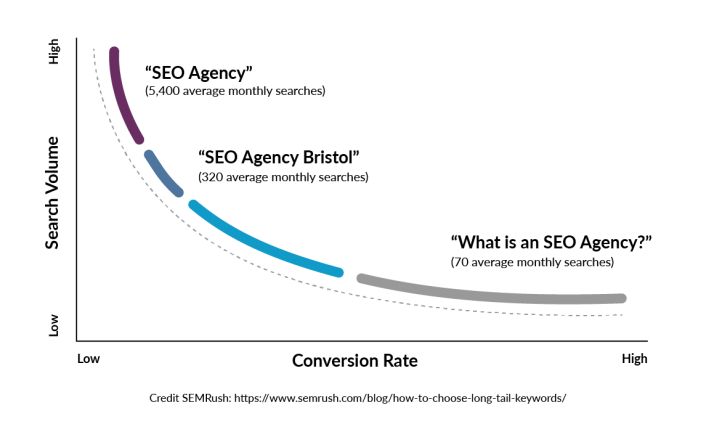
Source: Infographic courtesy of Semrush.
Optimize Long-Tail Keywords
Once you have established a nice pool of long-tail keywords, it is time to strategically integrate them into your site’s titles, headings, subheadings and body copy.
These keywords are especially beneficial for smaller sites, newer sites and low-authority sites that do not have a lot of established authority – as they have a tendency to draw a searcher’s attention and signal to the search engines that there is something of value to the consumer.

Conclusion
That wraps our brief look at keywords, how to identify keyword sweet spots, and concludes Edition No. 2 of our snapshot series. Stay tuned for the next snapshot article as we continue to bring another valuable digital marketing topic into focus.
Feel free to leave a comment below.
If you have not already done so, please don’t forget to Subscribe in order to receive periodic updates on valuable digital marketing strategies delivered right to your e-mail inbox!
See you in the next regular blog post or the next edition of the Digital Marketing Snapshot Series…

 Insightful Digital Marketing