

Table of Contents
- Key Takeaways
- Introduction: SEO for Attorneys
- Legal Search Statistics on Google
- Why the Top 3 SERP Results Matter
- Components of Legal SEO
- Key Google Ranking Factors for Attorneys
- Leading Forms of Legal Website Content
- Local SEO for Attorneys
- On-Page SEO for Attorneys
- Off-Page SEO for Attorneys
- Conclusion
Key Takeaways
- Why the Top 3 search engine results matter for attorneys;
- How to establish your website and blog as an authority on the law;
- The Top 10 most important Google ranking factors for a law firm website;
- How E.E.A.T. and YMYL influence whether people find your content online;
- Key sections that every law firm website should include in its overall design;
- The importance of claiming a free Google Business Listing for Local SEO;
- How to appear in Google’s “Local Pack” at the top of search engine results;
- 7 key factors for optimizing your website for on-page SEO or on-site SEO;
- Four areas of focus for maximizing your website for off-page or off-site SEO;
Introduction: SEO for Attorneys
A recent study by Brandmuscle concluded that attorneys rate SEO as the most effective marketing channel for acquiring new clients.
Google processes approximately 8.5 billion worldwide search queries per day – 3.5 billion in the United States alone. This works out to over 3 trillion searches on an annual basis!
Legal Search Statistics on Google
The average law firm achieved an impressive 3-year ROI of 526%, according to an SEO study by FirstPageSage.
Here is the formula for calculating ROI from SEO:
SEO ROI = (Value of Conversions – Cost of Investment) / Cost of Investment
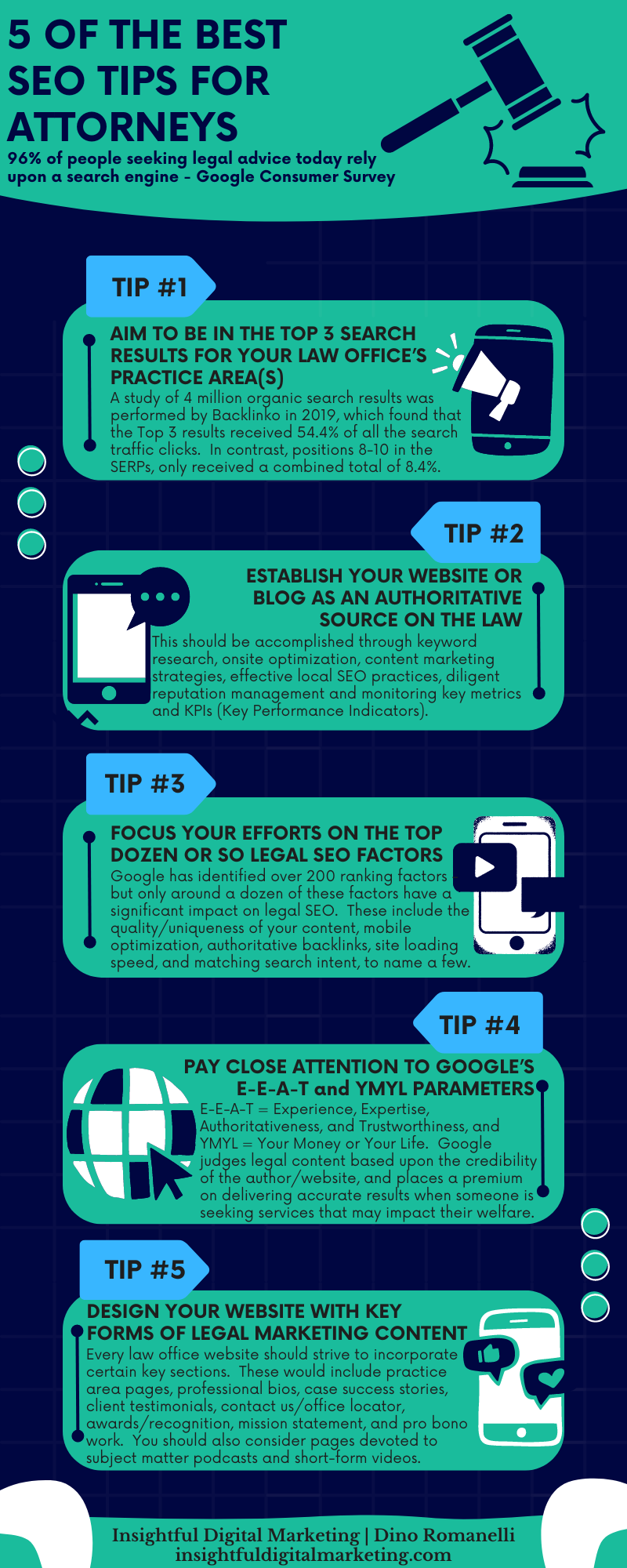
96% of people seeking legal advice rely upon a search engine according to a Google Consumer Survey. Whether a solo practitioner or a large law firm, SEO is absolutely vital for attracting and acquiring new clientele.
In addition to the above statistic, 62% of all searches for legal services are non-branded (e.g., “Denver real estate attorney”). As many as 72% of all consumers seeking legal advice, only contact a single law office.
Why the Top 3 SERP Results Matter
As mentioned above, Google processes around 8.5 billion searches a day. Almost 54% of all website traffic comes from pure organic searches.
If your website or blog is not in the first 3 search results, fewer prospective clients will contact your office.
SEO expert Brian Dean performed an analysis of 4 million Google search results to better understand click-through-rates.
The study found that the top 3 results receive almost 55% of all the clicks, with the top spot alone receiving almost 28%.
Here is how you would calculate your Organic CTR:
Organic CTR = Organic Clicks / SERP Impressions x 100
Example: 1,500 searches for “amusement park injury” in Google take place over the course of a month.
A website appears in the top 3 results 1,500 times. It is clicked 375 times.
Therefore, the Organic CTR for that keyword or keyphrase is 375 / 1,500 x 100 = 25%.
Once a consumer reaches the bottom of Page 1, the likelihood they’ll continue to Page 2, is slightly over one-half of one percent!
The No. 1 result on Google’s organic search listings these days is over 10 times more likely to receive search traffic than the No. 10 result (which under the old pagination system would still be considered on Page 1).
Here is a graph showing a breakdown of the organic CTR for the top 10 SERP results according to the Backlinko analysis cited and linked to above:
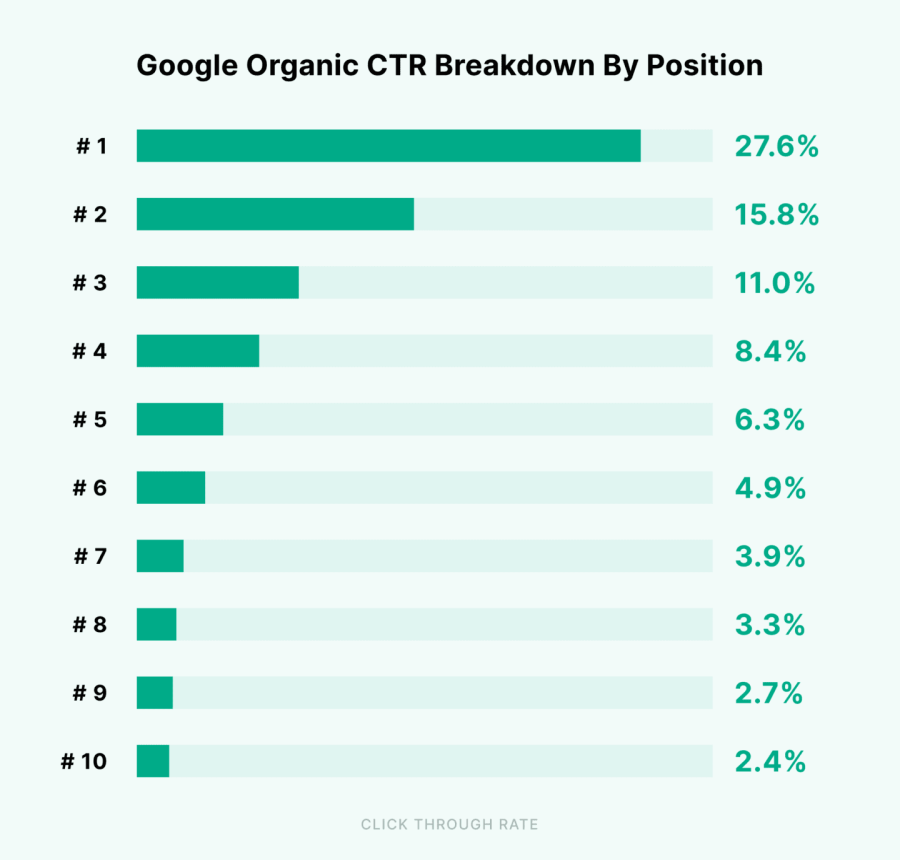
Source: Infographic courtesy of Backlinko.
Components of Legal SEO
The ultimate goal of integrating these digital marketing components into your law practice, is to establish your website or blog or YouTube channel, for example, as the definitive and most reliable resource for your particular practice area (e.g., San Diego DUI defense, Los Angeles unlawful detainer, Miami immigration services, and Atlanta personal injury claims).
The main components of SEO that legal practitioners should be aware of can be broken down into six (6) key categories:
Keyword Research
This as the process sounds, involves identifying keywords (e.g., “personal injury”) and keyphrases (e.g., “catastrophic personal injury attorney”) to target in organic and local search engine results.
Content Marketing
This is content such as a blog post on “What to do at the Scene of an Auto Accident”, a downloadable case study on seeking and obtaining punitive damages, or an infographic showing how a Chapter 7 bankruptcy case proceeds through the court system. There are many more content marketing assets that can be utilized to help increase your search engine rankings.
Onsite Optimization
This is the process of optimizing (incorporating) certain elements into your website design and content in order to maximize the amount of search engine traffic your site receives. For example, making sure keywords are integrated into your headings and subheadings (H1-H6).
Local SEO
Same as above, but with a focus aimed at increasing your search rankings whenever someone is seeking local services (e.g., Dallas employment law attorney), placing well on the Google Maps local pack listings, and maintaining a fully optimized Google Business Profile.
Reputation Management
Consumers these days pay close attention to the public perception of a legal service provider – especially online reviews left by current and former clients. It is important to seek out positive reviews from clients, and mitigate any negative reviews. You should provide a professional response to all reviews left for your firm.
Metrics and KPIs (Key Performance Indicators)
In order to measure your SEO progress and discover actionable insights, there are both free (e.g., Google Search Console and Google Analytics) and paid (e.g., Ahrefs and Semrush) software services available to the legal profession.
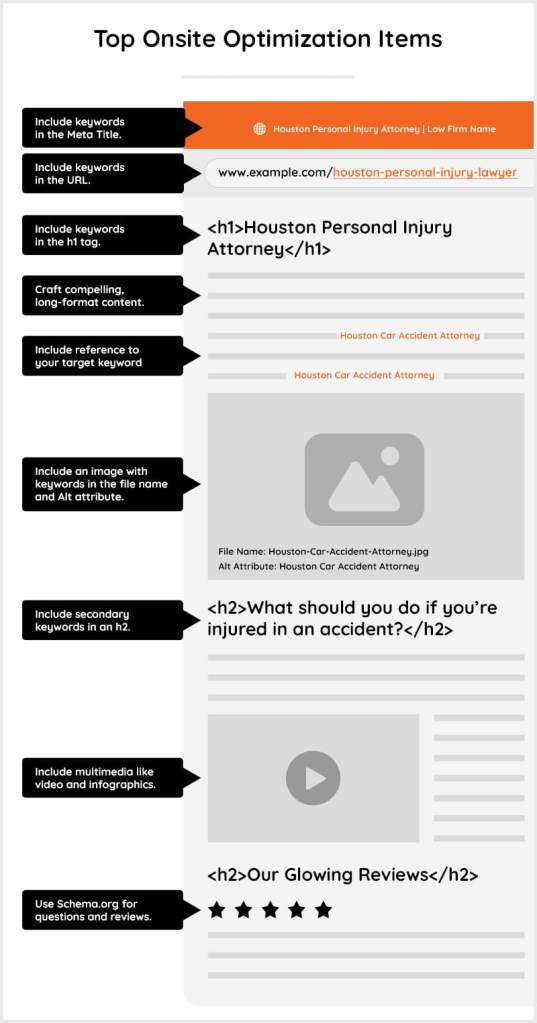
Source: Infographic courtesy of JurisPage.
Key Google Ranking Factors for Attorneys
There are over 200 Google Ranking Factors that have been identified by Backlinko. However, only around one-dozen of these factors have the greatest impact on SEO.
I am going to break down 10 of the top SEO factors that have been deemed to have the greatest impact on the rankings of a website or blog.
Content Creation
When drafting legal content for your web assets, you want to focus on creating content that is of high quality, as well as unique enough, to distinguish it from the other legal content that is available online.
This would be any written, audio or video content that is included on your website, blog, YouTube channel, etc.
Your content should be as unique as possible (different or better than what appears in the top SERP listings) – and informative enough to answer a searcher’s query. Longer content tends to rank better than shorter content.
Example: If someone does a search for “California DUI defense attorney” a blog post about “The 25 Most Successful DUI Defenses in California” would be a much more informative post than to have a short opinion piece about why most DUI fines are over-inflated.
Mobile Optimization
After a seven (7) year effort, Google states that it is now a mobile-first indexing platform. Meaning, Google will crawl your web content from the point of view of a mobile browser and use that for purposes of deciding how to index and rank your content.
If your website or blog is not optimized so that it displays in a user-friendly manner on a mobile device, you may be at risk of having your site demoted in the rankings or tagged with a warning!
Backlinks
I have discussed this topic in two of my prior blog posts: one addressing the importance of link juice or link equity, and another one addressing how to rank at or near the top of search engine results.
Suffice to say, the more relevant and authoritative backlinks you have pointing at your web content, the higher you will rank on search engines.
Domain Authority
Links pointing at your website or blog content also boost your Domain Authority.
The higher your Domain Authority – e.g., the No. 1 Google position has a DA rating of 80 vs. the No. 10 position which has a DA rating of 50 – the better your content will rank on the SERPs.
Site Loading Speed
This is a much more important factor than a lot people realize. Pay particular attention to how fast your site loads while being displayed on a mobile device – the rule of thumb is a site should load in three (3) seconds or less.
Kinsta has identified the top site speed testing tools. Here are the top three (3) from that list:
- Pingdom
- Google PageSpeed Insights
- Google Analytics Site Speed
Keyword Usage
If your goal is to rank for keywords or keyphrases, then you must optimize (incorporate) those words and phrases into your site content.
Example: If you want your law firm to rank for “spinal cord injury consultation”, then those keywords should be included in the following areas:
- A page’s URL;
- Your title or meta tag;
- The meta description;
- The H1 (and first H2) tags;
- First sentence of your content;
- The last sentence of your content;
Note: This would be the bare minimum areas your keyword(s) should be displayed.
There is no rule that says you have to use the exact word or phrase each time – adding keyword iterations such as “catastrophic spinal cord injury consultation” or “acute spinal cord injury consultation” would be a great practice for any law office wanting to rank as high up as possible in the SERPs.
Note: Be careful not to overuse your keywords or keyphrases (e.g., inserting 50-100 citations throughout a 2,500 word blog article would be excessive), because Google will consider that practice “keyword stuffing” and could get your page or site penalized in the rankings.
Machine Learning (aka Rank Brain)
Google has an artificial intelligence (AI) component to its algorithm which is referred to as “Rank Brain.” It is also considered one of Google’s top three (3) ranking factors.
Rank Brain’s job is at the heart of Google’s primary mission – to serve the best, most relevant search results, in response to a searcher’s query.
Search Intent
Does your content match what a search query is seeking? Google uses “Quality Raters” to determine how well search intent is satisfied by the search results.
Example, if a prospective client does a query for “what are the steps involved for obtaining a patent”, and your firm’s website has a page with an engaging infographic showing a flowchart of the patent application process that attracts a lot of clicks with a low bounce rate (when someone clicks the back button on their browser after only a brief visit), there is a much greater chance that your page or site will be pushed up the search rankings over time.
Content Updates
Stale content does not rank well on Google. That’s why it is important to update your web content on some sort of regular basis – every quarter, every year, etc. – to be sure it is still relevant since it was first published.
You should also consider placing a notation such as “Last Updated: November 1, 2023” to signal to your reader and to the search engines that they are reviewing fresh content.
Google uses User Experience Signals to determine the impact of updated content on user interactions. If they notice searchers “bouncing” away from your outdated content, it is going to hurt your search rankings.
YMYL and E-E-A-T
YMYL stands for Your Money Your Life, and E-E-A-T stands for Expertise, Experience, Authoritativeness and Trustworthiness.
Google places a special emphasis on delivering high quality results whenever someone is searching for information related to a topic that could significantly impact their health, safety and welfare. The legal profession certainly falls into that category. They also want to promote content that is authored by legitimate experts in a given profession.
When someone is searching for an attorney or legal counsel – they may just be browsing for basic legal information – or that person may be facing a very serious situation where legal services are needed right away!

Source: Infographic courtesy of Semrush.
Here are five (5) things you can do immediately to optimize for Google’s YMYL and E-E-A-T parameters:
- Create content that answers the reason a user went to Google in the first place to search;
- Example: If someone wants to know “how does a California DUI conviction impact insurance rates” you might show them a detailed chart or an engaging infographic which breaks down the following:
- Before and after comparison of rates from major insurance carriers;
- Misdemeanor convictions vs. felony convictions;
- First-time convictions vs. second-time convictions;
- BAC levels admitted into evidence;
- Bodily injury/property damage;
- Age of the driver at the time he/she was cited;
- Example: If someone wants to know “how does a California DUI conviction impact insurance rates” you might show them a detailed chart or an engaging infographic which breaks down the following:
- Identify all authors (attorneys, forensic experts, private investigators, etc.) of your content highlighting credentials and qualifications;
- Make it really easy for someone to get in contact with your firm or a specific attorney; an 800 number and a 24/7 client service line should be considered;
- Maintain a good online reputation and respond to all client reviews (good and bad) on platforms such as Yelp and your Google Business Profile;
- Make sure your website/blog is secured with an updated SSL certificate (with https:// in the URL address), and provides an optimal mobile experience for each user;
Leading Forms of Legal Website Content
Here are fifteen (15) forms of marketing content that every law firm website should strongly consider incorporating:
1. Practice Area Pages: Potential clients will visit your practice area pages in order to determine whether or not to hire your firm – this is considered one of the most important sections of your website due to its transactional nature.
2. Bio Pages or Meet Our Professionals: These pages establish the overall credibility of the legal professionals at the law firm. These would include information often found on a professional resume or a LinkedIn profile.
3. Blog Articles: Should be designed to satisfy the informational intent of a searcher’s queries. Example, someone enters “what are the steps of a divorce in California” and they discover a blog article you recently authored titled “The 7 Key Stages of a Contested California Divorce Proceeding”.
4. FAQs: These can be on their own dedicated FAQ page, or they may be integrated into your practice area pages depending on the FAQ topic.
5. Client Reviews/Testimonials: Internal website pages with testimonials or external links to reviews on your Google Business Profile, for example, which highlight the feedback you’ve received from current and former clients.
6. Case Successes: This is an opportunity to note some of the key case victories you’ve achieved over the years. Example, Auto vs. Pedestrian, $2.5 Million Jury Verdict For Our Client, August 2022, Orange County Superior Court.
7. Infographics: Engaging visual graphics that make it easier for people to relate to and understand a particular topic.
8. Videos: YouTube or TikTok style content that is usually designed to promote a firm’s offerings or inform a potential client about a specific legal concept.
9. Subject Matter Podcasts: Audio only recordings that are published onto a leading podcast platform such as Spotify or Pandora.
10. Contact Us / Office Locator / Maps: Make it easy for people to find and contact your office locations via telephone, a website contact form, a chat feature, an e-mail address, and driving directions from your Google Business Profile.
11. News & Industry Updates: This is a section where you can announce topics such as legislative changes, precedent-setting court decisions, geopolitical events, law firm hires, office additions, new practice or service areas, and other information that may affect a client’s business or personal welfare.
12. Mission Statement: A nice touch to add to a law office’s website – lets existing and prospective clients know the overall philosophy of what motivates your firm and its attorneys to perform legal services for the public. A famous inspirational quote or two may be added in this section which aligns with your overall mission.
13. Pro Bono or Legal Aid: Any work performed by attorneys in this context should be highlighted by referencing the attorney name, number of pro bono hours, dates and organization served.
14. Awards & Recognition: Highlight any industry accolades received by the firm and individual attorneys. Include badges or logos from the various organizations that you are authorized to use on your website. This can be placed on a dedicated web page or setup as an animated carousel on your homepage or in the footer of your website.
15. Site Map: The type of sitemap that I believe should be added to a firm’s website as part of the footer navigation is an HTML sitemap (designed for humans), which will help site visitors find their way around your content – because sometimes they get lost and need a point of reference, especially when moving around a large site.
Note: The other type of sitemap, an XML sitemap (designed for search engines), would typically be generated by your content management system or website hosting company such as WordPress, which could then be submitted to search engines to encourage crawling and indexing.
In Google, for example, you would accomplish this by adding your XML sitemap (e.g., yourdomain.com/sitemap.xml) into the Google Search Console.
These are some of the best forms of marketing that a law firm can invest their time and energy into these days.
Publishing valuable content on a regular basis will improve your website and social media traffic, and lead to higher quality prospects and increased client engagements.
Local SEO for Attorneys
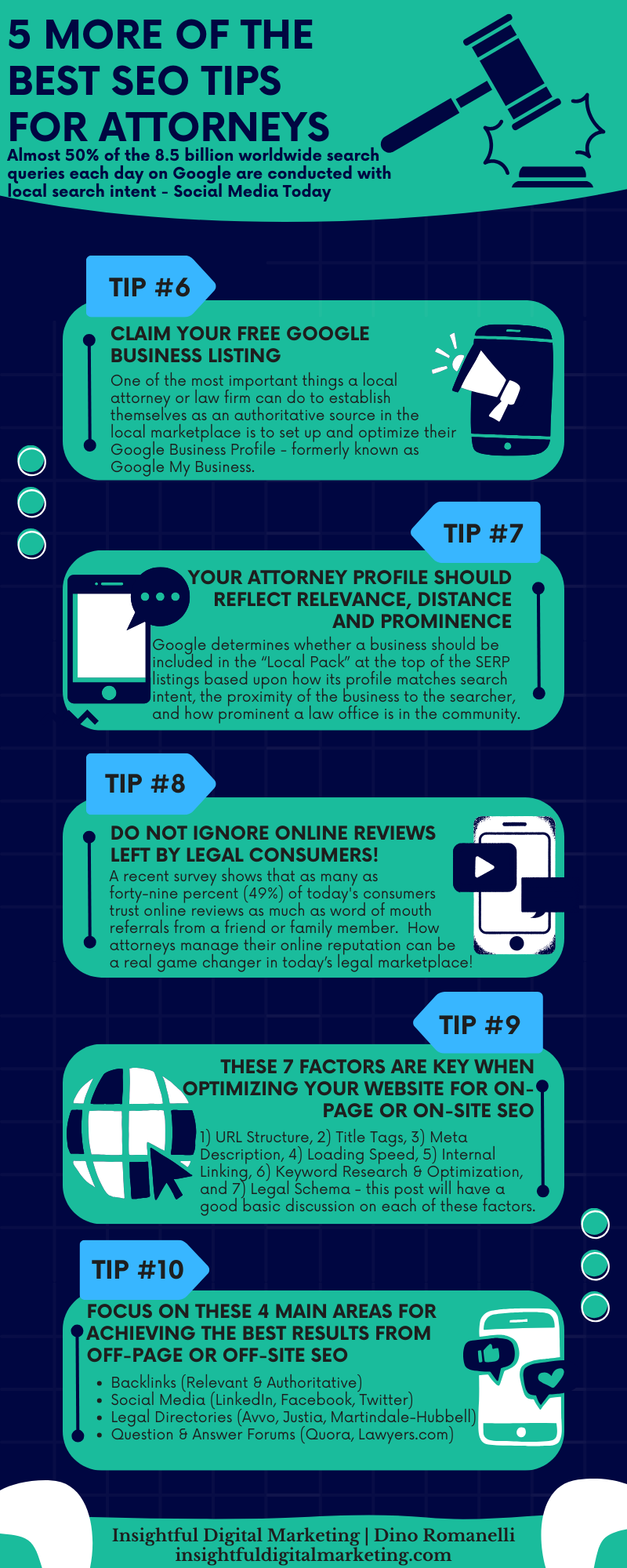
Did you know that almost fifty percent (50%) of the 8.5 billion worldwide searches conducted on Google each day are done with the intent to discover a locally-based product or service offering?
This is why it is critical for attorneys and law firms to be certain their websites, blogs, etc. are search engine optimized to take advantage of this local search intent.
If an individual conducts a search with local intent involved, then the Google Local Pack (also known as the 3-Pack) will be displayed ninety-three percent (93%) of the time, and usually sit just above or at the top of the organic portion of the Search Engine Results Page (SERP).
This will usually show 3 local organizations (e.g., businesses, schools, and points of interest) that match the intent of the search being performed, and will include a colorful map approximating the location of each featured entity.
Note: Additional local business listings can be accessed by choosing the “More Businesses” button just below the initial Local Pack listings.
If there are any sponsored (non-organic) listings showing up, then these would push the Local Pack section, along with the organic search results, further down the first section of the Google SERP. However, many SERPs have no sponsored listings, so the Local Pack shows up at the top or almost at the top of many searches.
Neil Patel, co-founder of NP Digital, conducted a Local SEO study of 119,221 URL/SERP listings, and as part of that study, it was revealed that forty-four percent (44%) of the time people were clicking on the Local Pack search results, nineteen percent (19%) of the time people were clicking on the Sponsored search results, and twenty-nine percent (29%) of the time people were clicking on the Organic search results.
That’s right, the Local Pack received more than twice as many clicks as the Sponsored listings, and significantly more clicks than the Organic listings!
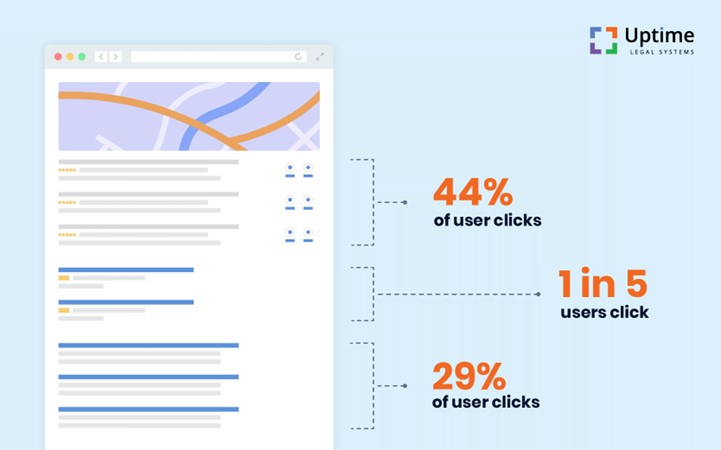
Source: Infographic courtesy of JurisPage.
Claim Your Free Google Business Listing
One of the most important things a local attorney or law firm can do to establish themselves as an authoritative source in the local marketplace is to set up and optimize your Google Business Profile – formerly known as Google My Business.
Oftentimes, even if your website or blog is not ranking very well organically in the SERP listings for certain keyword queries, your Google Business Profile may still show up at the top of the SERP results as part of the Local Pack if you have done a good overall job at optimizing your business listing (below is a discussion on how you can accomplish same).
Since studies have shown that the Local Pack receives more than twice the number of clicks as Sponsored Listings, and about fifty percent (50%) more clicks than Organic search results, it can be argued that the Local Pack and local SEO in general, is more important to small and medium size law offices than any other form of SEO.
This will of course be dependent upon your particular practice area(s). If you are a small boutique Bankruptcy firm offering services to various modest sized metropolitan areas, then the Local Pack becomes absolutely critical to target.
If you are a mid-sized law firm offering nationwide Class Action services, then the Local Pack becomes less critical to your business – although you could still optimize for each local area in which you offer those services.
How You Should Set Up Your Google Business Profile
Main Factors to Determine Rankings for Local SEO
Relevance
How closely does your Business Profile match the intent of the search query? If you are a family law attorney, you will want to optimize your site around keywords like “contested divorce”, “domestic violence”, “child support”, “legal separation”, “child custody”, and “supervised visitation”, to name a few.
Your Business Profile also allows you to add quality images, videos, and virtual office tours. You can also post blog-type articles or announcements on your Business Profile, to further enhance the relevance of your services.
Distance
This somewhat speaks for itself. Google basis the local results served in response to a query on the proximity or how close the searcher is to your law office’s brick and mortar location.
Since studies show that mobile devices now account for 63% of organic search traffic on Google, and most local searches are performed while traveling outside the home, it drives home the point of how important it is to have a website which is mobile-responsive and easy to navigate on a mobile device (a link to a law firm’s website should be included in every Google Business Profile).
Prominence
This factor addresses how much goodwill or business equity your firm has built up over the years, and how well known it is to the local community.
These can be influenced by the nature of the consumer reviews (good and bad) and how well you manage your response to each review.
A recent survey shows that 49% of today’s consumers trust online reviews as much as word of mouth referrals from a friend or family member. BTW, every review should receive a professional response from a law office.
Establishing authority via backlinks, and targeting as many legal directories as feasible, will also help to build your prominence in Google’s eyes.
Note: Backlinks should be sought from not only high authority, relevant websites with a national presence (e.g., Avvo, Martindale-Hubbell, and FindLaw), but also from local sources such as the chamber of commerce, visitors center, and city or county wide bar associations.
Here is an example of a nicely optimized Google Business Profile listing for a Criminal Defense law firm in Miami, Florida, that specializes in DUI defense services. This particular law office occupies one of the three (3) Local Pack listings under the keyword query “Miami Florida DUI Attorney”, and boasts a 4.9 Star Rating, across 198 reviews.

Source: Google Search Engine.
Google Business Profile Features
Be certain to utilize as many of the Google Business Profile features as possible.
These will include, but not be limited to, the following:
- Your hours of operation;
- An online appointment link;
- A link to your firm’s website;
- Managing consumer reviews;
- A complete listing of your legal practice areas;
- Posting blog-type articles or announcements;
- Photos of the attorneys and/or staff members;
- A virtual tour of your office space (if appropriate);
- Responding to questions posed in the Q&A section;
- Name, address, and phone number (“NAP”) of your business;
- Verifying your areas of coverage on Google Maps (city, county, towns, etc.);
- Analytical features such as daily call tracking, monthly profile views, website visitors from your profile, client messages received, appointments booked, and direction requests – Google refers to these metrics as profile interactions;
Note: Client reviews can be a deal breaker when it comes to deciding which law firm to hire – that’s why it is critical to respond to both good and bad feedback in as timely and diplomatic a manner as possible.
On-Page SEO for Attorneys
This is sometimes referred to as On-Site SEO. In order to improve your SERP rankings over the course of several months, and maintain those rankings over the years, you need to optimize your web content by enhancing your website architecture, incorporating HTML code that is search-engine friendly, continually improving the content itself, and making sure it is mobile-friendly.
7 Factors When Optimizing A Law Site for On-Page SEO
URL Structure
Shorter URLs have better ranking odds than longer URLs;
URLs that have a flat structure – e.g., yourlawfirm.com/truck-accident-lawyers – are easier for search engines to understand and also ensures that your keywords (in this case “truck accident lawyers”) are not buried in a long, complicated URL;
A good rule of thumb for small and medium-sized law firms: None of your website’s pages should be more than 3 clicks deep into your site’s architecture – otherwise, you risk compromising your visitor’s experience and your SEO efforts;
Title Tags
This will show up on the Google SERP;
Your page titles should not be more than sixty (60) characters in length (this includes spaces!) – otherwise, Google will likely truncate your title as it appears in the SERPs;
The preferred order for a title tag would be to include your location and keyword first, and your firm’s name last – e.g., “Houston Truck Accident Lawyers | Big Rig Injuries | ABC Law”;
Meta Descriptions
This will show up on the Google SERP, and garners a lot of attention from searchers.
Your meta description should not be more than 150 characters in length (this includes spaces!) – otherwise, Google will likely truncate your meta description as it appears in the SERPs.
A well written meta description gives Google and visitors a more detailed idea about your page’s content – and can lead to higher click through rates and more time spent on a law firm’s website.
Page Loading Time
Your site’s home page or landing page should load in three (3) seconds or less – otherwise, you start to lose potential visitors as each additional second ticks away.
As previously mentioned, Google has a free tool called PageSpeed Insights. Anyone can use this to analyze everything from page/site speed, SEO, accessibility, and best practices (like how well you use Alt Text to describe the images on your website).
Any score on PageSpeed Insights that falls below an 80 should be addressed – ideally, you want to score 90 or above on all these metrics.
Internal Linking
The one form of linking that you have complete control over, are the internal links that flow from one page to another on your website.
Choosing the right anchor text (the words you choose to link from) is important for helping Google and visitors to understand how each page is related to the other.
You should aim for three (3) to five (5) internal links on each page of your website, pointing to other pages on your website.
Keyword Research/Optimization
This section was covered in a prior blog post I authored on this subject matter.
Hubspot also published two very good articles on understanding the basics of keyword research and keyword optimizing your website.
Legal Schema
In a nutshell, legal schema helps Google to better understand the essence of your law firm’s website, place your site’s content into the best category buckets, and optimize how your site is ranked on the SERP listings.
You could hire an SEO professional or use a third-party schema generator.
Here is a brief list of some of the more popular schema markup generators:
Google Structured Data Markup Helper
Merkle’s Schema Markup Generator
All In One Schema Rich Snippets
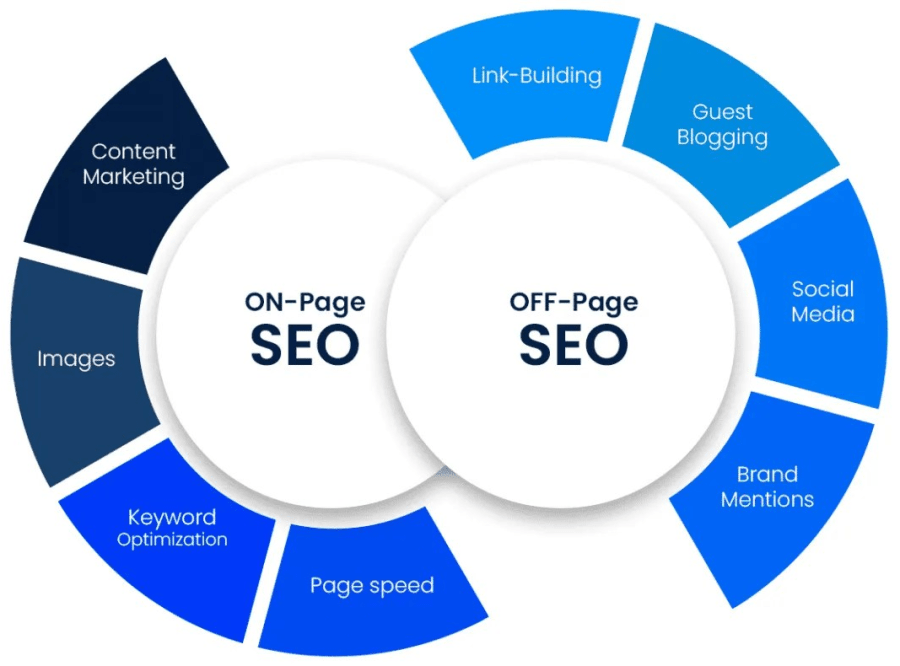
Source: Infographic courtesy of LawRank.
Off-Page SEO for Attorneys
This is also referred to as Off-Site SEO. While the essence of this blog post is geared towards Local SEO and On-Page SEO, I don’t want to completely ignore the critical aspects of Off-Page SEO.
4 Main Areas of Off-Page SEO for Law Firms
Backlinks
There is a lot of speculation as to how relevant backlinks are to SEO. Nonetheless, backlinks are still considered by Google to be an important factor for determining how to rank content responsive to a search query.
The key is to obtain backlinks from relevant and authoritative sites – the exception to this guideline would be if you are able to obtain links from super authoritative sites like Forbes, CNN, or the NY Times, then the relevance factor is far less important.
Preferably, you would like your backlinks to be a part of the main content on the linking website, and you would want the anchor text to be relevant to your content – “Click here” is far less effective than “Case success stories by the ABC Law firm”.
As discussed above, Local SEO can also benefit from specific types of backlinks – e.g., Local Directories, Chambers of Commerce, Consumer Review sites (like Yelp), your Google Business Profile, and Legal Directories (like Avvo ) that contain a reference to your law office name, address, phone number, e-mail and website.
Social Media
I previously authored a two-part series on Social Media Marketing – suffice to say, there are endless ways that attorneys and law firms can take advantage of the various social platforms available.
Every law office should have a company or business page on LinkedIn, Facebook, and Twitter – at a bare minimum.
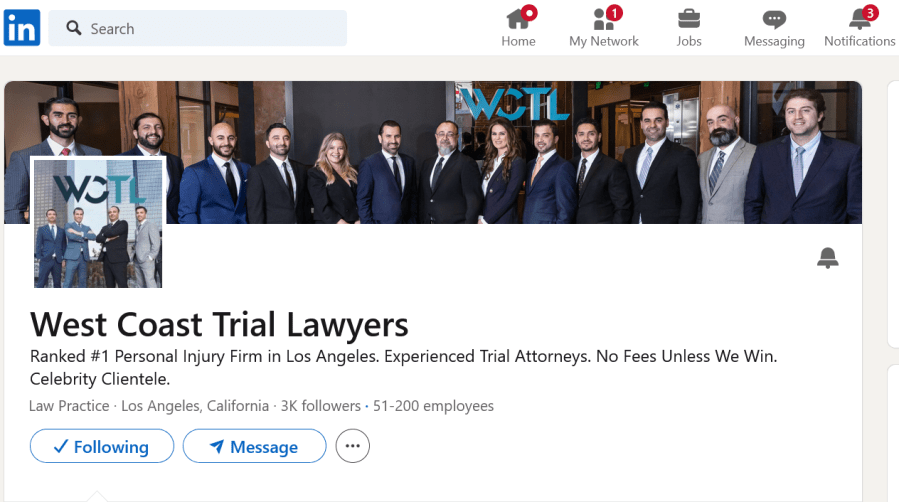
Source: LinkedIn.
In addition, video platforms such as YouTube and TikTok can also be valuable places to raise brand awareness and attract potential clients; lastly, social discussion sites like Reddit can be great sources for news aggregation, content rating, and for understanding what today’s legal consumer is seeking in terms of services.
Legal Directories
As briefly touch on above, industry-specific directories such as Avvo, Justia, Martindale-Hubbell, FindLaw, and your own State Bar Profile, to name a few, are opportunities for you to expand your digital presence as an individual attorney or law firm.
Note: A tool that you can use to find what sites (both local and national) are linking to your competitor’s domains, is called the Link Intersect Tool by Ahrefs. You may discover your competition has links from sites like Expertise.com and Mapquest.com, that you may not have otherwise considered for link building opportunities!
Question and Answer Forums
Reddit would fall in this category as well as other platforms like Quora, Avvo, and Lawyers.com,
Engaging with legal consumers and providing meaningful and timely responses to their questions, will help to increase your brand’s awareness and establish your law office as an authoritative source on a particular area of law(s).
This may also help you to attract backlinks to your own website, and send appropriate E-E-A-T (Expertise, Experience, Authoritativeness and Trustworthiness) signals to Google as a catalyst for an increase in your website’s rankings!
Conclusion
What types of website content does your law firm website feature? Do you optimize your content around specific keywords?
How frequently do you update your website or blog content? Do you believe your website or blog articles match the intent of the inquiries made by potential clients?
What types of Local SEO and On-Page SEO has your law firm incorporated into its business operations? Do you find certain methods work better than others at improving your website rankings and attracting clientele?
Are there any methods or techniques I have not covered, that you believe would be of value to a law practice?
Feel free to leave a comment below.
If you have not already done so, please don’t forget to Subscribe in order to receive periodic updates on valuable digital marketing strategies delivered right to your e-mail inbox!
See you in the next blog post…

 Insightful Digital Marketing